Commercial cleaning services rates: 2026 guide for Australian businesses
Australian commercial cleaning services rates typically run at an hourly rate for general office work, or a per square metre monthly charge for recurring contracts, with per-visit costs varying widely by site size and service scope.
Here’s what that looks like in practice:
- Typical hourly range: an hourly rate for standard commercial cleaning; specialist or after-hours work runs higher
- Per-sqm monthly range: a range for standard offices; higher rates for healthcare, hospitality, and compliance-heavy sites
- Per-visit ranges: Small to medium offices have varying per-visit costs; larger sites often quoted on monthly contracts
- One-off deep cleans: Typically priced higher due to scope variability for small-to-medium commercial spaces; end-of-lease cleans vary by scope
Three quick caveats before you use any of these figures. First, check that the Fair Work Award base rate is reflected in any quote — the Award base rate sets a minimum labour floor, and bids that look suspiciously cheap often signal underpaid staff. Second, confirm whether GST is included or added on top. Third, clarify whether consumables and equipment are bundled or billed separately.
Table of Contents
- How do Australian commercial cleaners price their work?
- What factors push commercial cleaning prices up or down?
- What do common commercial cleaning jobs actually cost?
- How do rates vary across Sydney, Melbourne, Brisbane, and Perth?
- Three practical ways to estimate your cleaning budget
- How to brief suppliers and spot red flags in quotes
- How we price commercial jobs — what’s included and why
- Key takeaways
- A Melbourne operator’s perspective on what quotes don’t tell you
- Get a Melbourne commercial cleaning quote with no surprises
- Useful sources for checking rates and compliance
How do Australian commercial cleaners price their work?
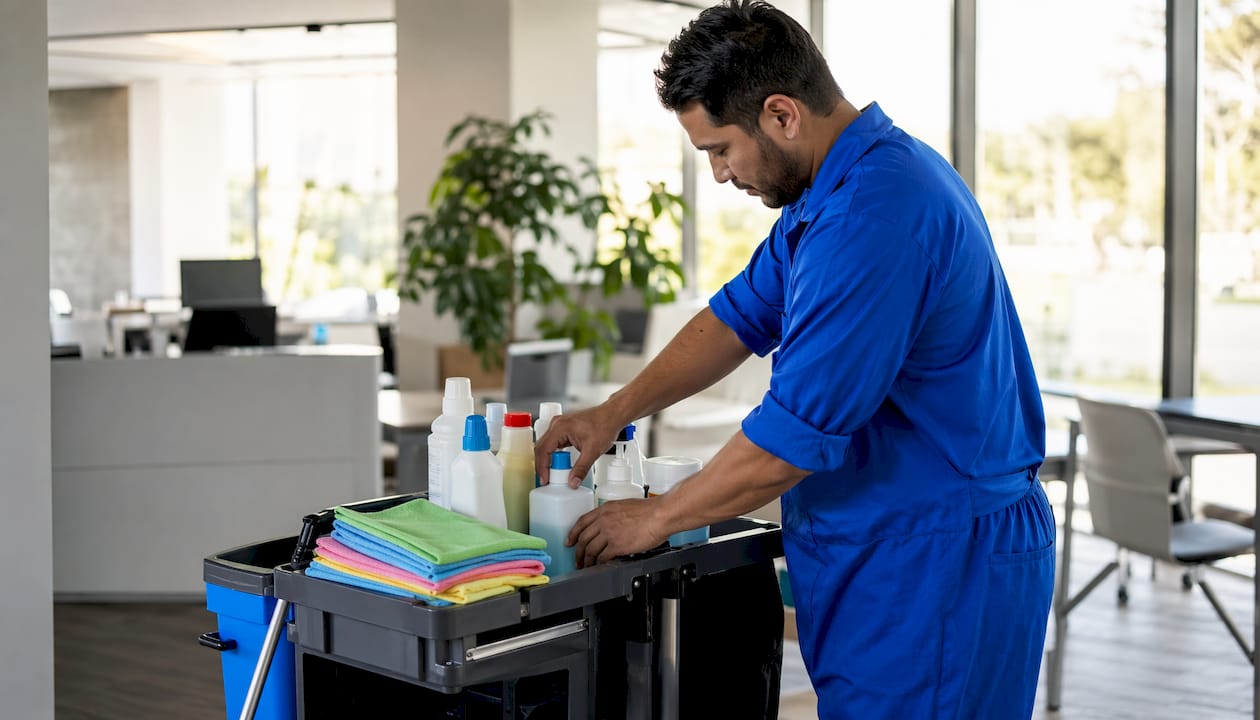
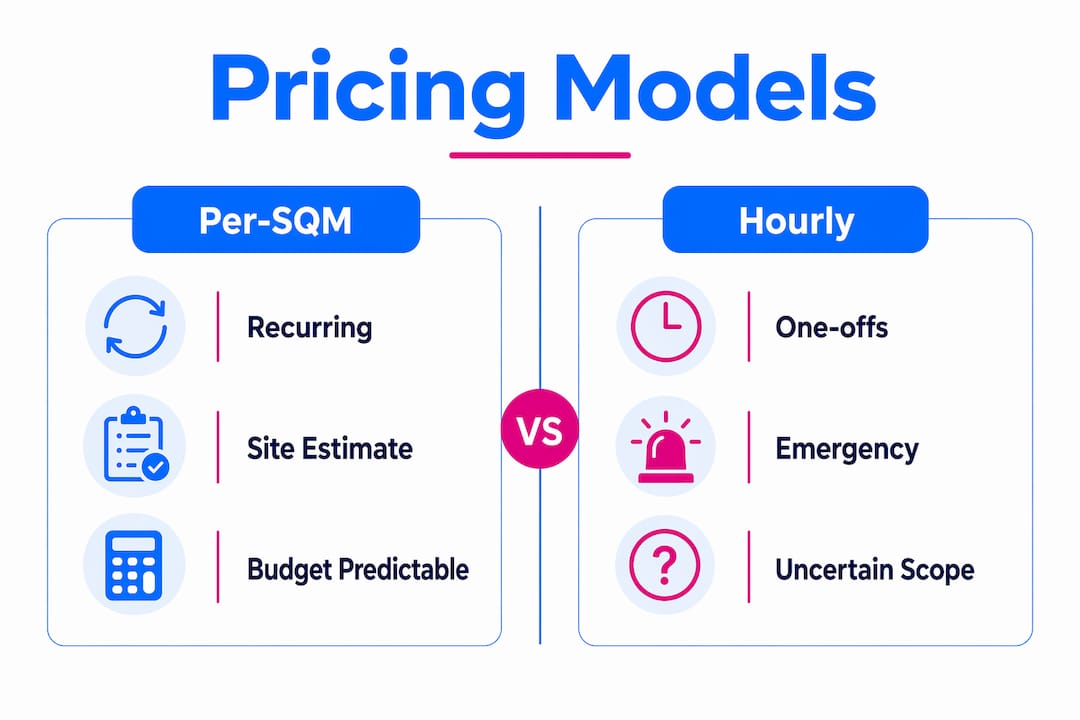
Three pricing models dominate the market, and most suppliers use a hybrid of at least two.
Per-square-metre (per-sqm) pricing
Per-sqm pricing is the standard for recurring contracts. The supplier estimates how long your site takes to clean, converts that into a monthly cost, then divides by your floor area to arrive at a per-sqm rate. It simplifies budgeting for clients and rewards efficiency on larger sites — a supplier who cleans 2,000 sqm faster than a competitor earns a better margin without charging you more. The practical range for standard offices sits between $0.12 and $0.18 per sqm per month; healthcare and high-compliance sites are typically quoted at $0.18–$0.35.
Hourly pricing
Suppliers reach for hourly rates on one-off jobs, post-construction cleans, emergency work, or any scope that is genuinely hard to predict. It protects them from scope creep. A quoted hourly rate should include the cleaner’s loaded wage, equipment, and a margin — not just the Award base rate. When you see an hourly quote well below $40, ask what’s excluded.
Flat per-visit and contract pricing
A flat per-visit fee is what most clients actually see on an invoice. The supplier calculates it internally from hours and sqm, then presents a single number per clean. Flat-rate pricing suits established recurring contracts where the scope is locked and predictable. The risk for buyers is that a vague scope lets a supplier cut corners without technically breaching the contract.
Conversion example: A 1,000 sqm office at $0.15/sqm/month = $150/month. If that’s cleaned weekly (roughly 4.3 visits/month), the effective per-visit cost is about $35 — which only makes sense if the clean takes under an hour. A more realistic weekly clean of a 1,000 sqm office takes 2–3 crew-hours, so a fair per-visit price is closer to $90–$195 at $45–$65/hr. If the per-sqm maths produces a per-visit figure that implies under $40/hr labour, the quote is likely underloaded.
| Pricing model | Best for | Budget predictability | Main risk |
|---|---|---|---|
| Hourly | One-offs, unclear scopes | Low | Costs blow out if scope grows |
| Per-sqm monthly | Recurring contracts, large sites | High | Misses scope complexity |
| Flat per-visit | Recurring, fixed scope | High | Supplier cuts corners on vague scopes |
| Hybrid (sqm + hourly add-ons) | Mixed-use sites | Medium | Harder to compare quotes |
Pro Tip: Ask every supplier to show you the crew-hours assumption behind their per-sqm or flat-rate quote. If they can’t or won’t, that’s the answer.
What factors push commercial cleaning prices up or down?
These are the items that most materially move a bid. Check each one before signing anything.
- Facility type and layout. Open-plan offices clean faster than facilities with many small rooms, restrooms, or partitioned areas. More restrooms per floor area is one of the biggest cost drivers in standard office pricing.
- Cleaning frequency. More frequent cleans mean less buildup per visit and lower per-visit labour time — but higher total monthly spend. Weekly cleans typically cost less per visit than fortnightly, because the site never gets heavily soiled.
- Scope and service level. Basic vacuuming and bin emptying sits at the low end. Add restroom sanitisation, kitchen cleaning, and touchpoint disinfection and the price climbs. Specialist tasks (carpet, floor stripping, window cleaning) are almost always quoted separately.
- Foot traffic and soil load. A retail store or café with heavy daily traffic needs more time per sqm than a quiet professional office. Suppliers price this into the rate or the hours estimate.
- Number of cleaners and supervision. A two-person crew costs more per visit than a solo cleaner but finishes faster — relevant when after-hours access windows are tight.
- After-hours and weekend work. Evening and weekend cleaning attracts penalty rates under the Cleaning Services Award, which flows directly into the quoted price. CBD sites that can only be accessed after 6 PM will cost more than suburban offices with flexible access.
- Access complexity. Secure buildings, multi-level sites, or facilities requiring inductions (construction sites, hospitals) add time and cost. Some suppliers charge a site-induction fee separately.
- Consumables and equipment. Confirm whether cleaning products, bin liners, paper goods, and equipment are included. Some suppliers quote labour only and bill consumables at cost-plus.
- Insurance and compliance costs. Public liability insurance, workers’ compensation, and any industry-specific compliance (healthcare infection control, food-safe certification) are legitimate cost components. A supplier who can’t produce certificates of currency is a red flag.
- Travel and minimum fees. Regional or outer-suburban sites often attract a travel fee or a minimum-visit charge. In metro areas, parking costs for the crew may be passed through.
Pro Tip: To compare quotes properly, normalise them to the same frequency, the same included tasks, and the same consumables arrangement. A quote that looks 20% cheaper often excludes products or equipment the other supplier bundles in.
The labour floor matters here. Award base rates set the minimum, but loaded labour (super, leave loading, WorkCover, and supervision) typically runs 30–40% above the base wage. Any bid that implies an all-in labour cost below that loaded floor is either cutting staff entitlements or cutting corners on the clean.
What do common commercial cleaning jobs actually cost?
Prices below are Australian market ranges. They are indicative benchmarks, not fixed quotes — your site, frequency, and scope will move the final number.
| Service | Typical price range | Pricing basis |
|---|---|---|
| Standard office cleaning | $0.12–$0.18/sqm/month | Per-sqm recurring |
| Healthcare / medical | $0.18–$0.35/sqm/month | Per-sqm recurring |
| Retail / hospitality | $0.18–$0.35/sqm/month | Per-sqm recurring |
| One-off deep clean | $45–$65/hr or $0.15–$0.20/sqm | Hourly or per-sqm |
| Commercial carpet cleaning | — | Per-sqm per service |
| Tile and grout cleaning | — | Per-sqm per service |
| Floor stripping and waxing | — | Per-sqm per service |
| Window cleaning | $2–$5 per window (interior/exterior) | Per window |
| End-of-lease clean | $300+ (small-medium site) | Flat per job |
| Post-construction clean | Quoted individually | Hourly or flat |
Worked example — 1,000 sqm office, weekly cleaning:
- Per-sqm rate: $0.15/sqm/month
- Monthly cost: 1,000 × $0.15 = $150/month
- Weekly visits: approximately 4.3 per month
- Effective per-visit cost: $150 ÷ 4.3 = ~$35 per visit
As noted above, $35 per visit for a 1,000 sqm office implies under one crew-hour — which is unrealistic for a thorough clean. A more honest estimate at $45–$65/hr with a 2-hour crew visit gives $90–$130 per visit, or roughly $390–$560/month. Use the hourly cross-check to validate any per-sqm quote.
Specialist tasks are almost always itemised separately because they carry distinct equipment, consumable, and drying-time costs. Budget carpet cleaning, floor stripping, and window cleaning as line items outside your base contract.
Scale economy is real: per-sqm rates typically fall as site size grows, because fixed setup time is spread across more floor area. A 500 sqm office might pay $0.18/sqm; a 5,000 sqm site with the same supplier often negotiates down to $0.13–$0.15/sqm.
- Add-on services commonly quoted separately: restroom consumables (paper, soap), floor stripping and recoating, carpet encapsulation, electrostatic disinfection, pressure washing, and post-event cleans.
How do rates vary across Sydney, Melbourne, Brisbane, and Perth?
Australian commercial cleaning pricing is not uniform. High-cost metro markets can run 20–40% above national averages, driven by higher Award penalty rates, CBD parking costs, and tighter after-hours access windows.
- Sydney: Hourly rates commonly quoted at $50–$65/hr for standard commercial work; CBD sites with after-hours access requirements sit toward the top of that band. Per-sqm monthly rates for offices are typically $0.15–$0.20.
- Melbourne: Office cleaning rates generally $45–$60/hr; CBD and inner-suburb sites attract after-hours premiums. Per-sqm monthly for standard offices $0.13–$0.18. Carpet and tile specialists in Melbourne’s CBD often quote separately from the base contract.
- Brisbane: Hourly rates typically $40–$58/hr; slightly lower than Sydney and Melbourne for equivalent scope. Subtropical climate means air-conditioning duct cleaning is a more common add-on.
- Perth: Comparable to Brisbane at $40–$58/hr for standard work; mining-adjacent industrial sites and FIFO accommodation facilities attract specialist rates well above standard office pricing.
- Regional and outer-suburban sites: Expect a travel fee ($20–$60 per visit is common) and sometimes a minimum-visit charge. Per-sqm rates may be lower than CBD equivalents, but travel costs can offset the saving for smaller sites.
Pro Tip: If your site is in a CBD building with security inductions or restricted after-hours access, flag this upfront. Suppliers who discover access complexity after quoting will either reprice or absorb the cost by rushing the clean.
State-level licensing requirements also vary. Some states require cleaning contractors to hold specific licences for healthcare or food-handling environments. Confirm your supplier holds the relevant credentials for your facility type before signing a contract.
Three practical ways to estimate your cleaning budget
Use these methods to sense-check a quote before you receive it, or to build an internal budget figure.
Method 1 — Per-sqm monthly estimate
Multiply your floor area (sqm) by a rate from the table above that matches your facility type and frequency. A 2,000 sqm standard office at $0.15/sqm/month = $3,000/month. Adjust up if you have a high restroom ratio or require daily cleaning.
Method 2 — Crew-hours conversion
Estimate how many crew-hours your site needs per visit. Multiply by crew size, then by hourly rate, then by visits per month.
Formula: Crew size × hours per visit × hourly rate × visits per month
Example: 2 cleaners × 2.5 hours × $55/hr × 4 visits = $1,100/month for a mid-sized office.
Method 3 — Production-rate conversion
Use a production-rate approach: estimate how many sqm one cleaner covers per hour for your facility type (typically 300–500 sqm/hr for open-plan offices, lower for complex layouts). Divide your total floor area by that rate to get crew-hours, then price as above.
Example: 1,500 sqm ÷ 400 sqm/hr = 3.75 crew-hours per visit. At $55/hr with one cleaner: $206 per visit, or $825/month for weekly cleaning.
Budget contingency: Add 10–20% to your first-quote estimate for one-off deep cleans or new contracts. Suppliers often discover site quirks (extra restrooms, heavily soiled areas, access delays) that weren’t visible at quoting stage.
How to brief suppliers and spot red flags in quotes
A well-structured brief gets you comparable, honest quotes. A vague brief gets you low-ball bids that blow out after month one.
Questions to include in every request for quote:
- What is the exact scope — which areas, tasks, and frequencies are included?
- Are consumables (cleaning products, bin liners, paper goods) included or billed separately?
- What equipment does the crew bring, and is equipment hire charged separately?
- What insurance does the supplier hold (public liability, workers’ compensation)? Can they provide certificates of currency?
- Are staff employed directly or subcontracted? How are Award rates and entitlements managed?
- What training do cleaning staff receive, and is it documented?
- What are the key performance indicators and how are complaints handled?
- What are the contract term, notice period, and cancellation conditions?
- Are there auto-renewal clauses, and how much notice is required to exit?
- Can the supplier provide references from comparable sites?
Red flags to watch for:
- Hourly rates well below $40/hr with no explanation of what’s excluded
- No mention of Award compliance, insurance, or staff entitlements
- Vague scope descriptions (“general cleaning as required”)
- No references or verifiable track record
- Aggressive auto-renew terms with long notice periods (90+ days)
- Consumables and equipment listed as “TBC” or excluded without a clear cost estimate
To compare quotes fairly, normalise each one to the same frequency and inclusions, then calculate an effective per-sqm or per-visit rate. A quote that bundles consumables at $0.16/sqm is often better value than a bare-labour quote at $0.13/sqm once you add products back in. For end-of-lease cleaning, always request a line-item breakdown rather than a single flat price.
How we price commercial jobs — what’s included and why
Transparent pricing starts with loaded labour, not a market rate plucked from a competitor’s website. The correct approach is to build the price from the bottom up: calculate the actual wage cost (including super, leave loading, and WorkCover), add equipment and consumable costs, apply a margin for insurance and overhead, then add GST.
A sample line-item quote structure for a Melbourne commercial site looks like this:
- Labour (loaded): Crew hours × loaded hourly rate (Award base + super + leave + WorkCover)
- Consumables: Eco-friendly cleaning products, bin liners, paper goods (bundled or itemised)
- Equipment use: Amortised cost of vacuums, steam cleaners, floor machines
- Insurance and compliance: Public liability, workers’ compensation, any site-specific induction costs
- Margin and overhead: Business operating costs, supervision, quality checks
- GST (10%): Applied to the subtotal per ATO requirements
Standard inclusions in a fully loaded commercial quote from a reputable Melbourne provider:
- Trained and insured cleaning staff
- Eco-friendly, chemical-free cleaning products
- All equipment (vacuums, steam cleaners, mops, microfibre systems)
- Public liability and workers’ compensation insurance
- Satisfaction guarantee and complaint resolution process
Typical exclusions (quoted separately):
- Carpet steam cleaning and encapsulation
- Tile and grout deep cleaning
- Floor stripping, sealing, and recoating
- Window cleaning (exterior above ground level)
- Consumable restocking (paper towels, soap, bin liners) unless bundled
For aged-care and healthcare facilities, infection-control protocols and the use of hospital-grade disinfectants add to the base cost and should be itemised explicitly. This is not an area where the cheapest bid is the right bid.
Key takeaways
Australian commercial cleaning costs are driven primarily by loaded labour, site complexity, and frequency — and the gap between a transparent line-item quote and a vague low-ball bid is often 30–40% of the real monthly cost.
| Point | Details |
|---|---|
| National hourly benchmark | Standard commercial cleaning runs $45–$65/hr; specialist and after-hours work sits higher. |
| Per-sqm monthly range | Standard offices: $0.12–$0.18/sqm/month; healthcare and compliance-heavy sites: $0.18–$0.35/sqm/month. |
| Top three cost drivers | Facility type and restroom ratio, cleaning frequency, and after-hours or weekend access requirements. |
| Estimating method | Use the crew-hours formula (crew size × hours × rate × visits) and cross-check against per-sqm figures. |
| Com’s Melbourne service | Rony’s Carpet Steam offers line-item commercial quotes covering carpet, tile, end-of-lease, and eco-friendly recurring cleans across Melbourne. |
A Melbourne operator’s perspective on what quotes don’t tell you
Most pricing guides treat commercial cleaning as a maths problem — multiply sqm by a rate and you’re done. The reality is messier. Sites that look straightforward on paper often have a lift that’s out of service, a kitchen that hasn’t been deep-cleaned in two years, or a security system that adds 20 minutes to every visit. None of that shows up in a per-sqm rate.
The suppliers who price honestly account for those variables upfront, either through a site inspection or by building a contingency into the quote. The ones who don’t will either cut the clean short or come back with a variation after month one. A line-item quote is the clearest signal that a supplier has actually thought through your site rather than plugging your sqm into a spreadsheet.
On compliance: Fair Work Award rates and workers’ compensation insurance are not optional extras. They are the floor under every legitimate bid. If a quote implies labour costs below the loaded Award rate, the shortfall is coming from somewhere — usually staff entitlements or the quality of the clean.
Get a Melbourne commercial cleaning quote with no surprises
Rony’s Carpet Steam provides commercial cleaning across Melbourne with a clear, line-item quote process. Services cover carpet steam cleaning, tile and grout cleaning, end-of-lease cleans, and recurring office and facility cleaning — all using eco-friendly, chemical-free methods delivered by trained and insured staff.
Every quote starts with a site inspection or a detailed phone brief, so the price you receive reflects your actual site, not a generic sqm calculation; for trusted local options, consider Cleaning Services Melbourne | Onyx Removals. You get a full line-item breakdown showing labour, consumables, equipment, and GST separately — no hidden add-ons after you sign. For aged-care, healthcare, and hospitality clients, infection-control protocols and specialist equipment are included in the scope from day one.
Request a site inspection or get a quote online — turnaround is typically within one business day.
Useful sources for checking rates and compliance
These are the primary sources to consult when verifying labour costs, GST obligations, and industry benchmarks:
- Fair Work Commission — Cleaning Award: Check current Award base rates and penalty rates for after-hours, weekend, and public holiday work. Use this to verify that a supplier’s loaded labour cost is above the Award floor.
- ATO — GST guidance: Confirm whether quotes are GST-inclusive or exclusive. Commercial cleaning is a taxable supply; GST applies at 10% on the service fee.
- ISSA — Cleaning & Facility Solutions: Industry body publishing per-sqm and per-sq-ft benchmarks useful for sanity-checking quotes against international and local norms.
- SafeWork Australia: Relevant for workplace health and safety obligations, particularly for cleaning in healthcare, food-handling, and industrial environments.
- MSR Services — Australian pricing commentary: Local market write-up with Australian hourly rate context.
One practical note: use these sources to verify that a supplier’s quoted labour rate is consistent with the loaded Award cost, and that the invoice total includes GST. A quote that arrives GST-exclusive can add 10% to your budget if you’re not registered for GST input tax credits.
This article provides general pricing information for budgeting purposes. Confirm current Award rates with the Fair Work Commission and GST obligations with the ATO or a qualified accountant for your specific situation.
Recommended
- How Much Does Professional Carpet Cleaning Cost in 2026? The Melbourne Price Guide
- Professional Office Cleaning Melbourne: The 2026 Guide to a Productive Workspace –
- Premium Office Carpet Cleaning Services Melbourne: The 2026 Business Guide –
- Professional Cleaning Services Melbourne: The 2026 Specialist Guide –
