Shag rug cleaning made easy: 10 simple steps
The safest way to clean a shag rug is suction-only vacuuming combined with blotting spills the moment they happen. Skip the beater bar, skip the steam, and skip anything that soaks the backing before you know what fibre you’re dealing with. That single habit, done weekly, stops most of the damage before it starts.
Here’s what to do in the next fifteen minutes:
- Switch your vacuum to suction-only or fit the upholstery/hose attachment. No spinning brush roll.
- Blot any fresh spill straight away with a clean white towel. Press, don’t rub.
- If the rug is small enough to lift, take it outside and shake it out over a railing or clothesline.
- Check the care tag before you do anything else. Wool and viscose behave very differently from synthetic shag.
Pro Tip: Keep a stack of plain white microfibre cloths near the rug. Coloured towels can bleed dye into wet fibres, especially on lighter shag.
Call a professional sooner rather than later if the rug is wool or silk, if it’s large enough that you can’t dry it flat within a day, if a stain has already set, or if there’s a lingering odour that spot cleaning hasn’t shifted. Those situations turn a simple job into an expensive mistake if handled with the wrong product or method.
Key Takeaways
The safest shag rug cleaning routine combines weekly suction-only vacuuming, immediate blotting of spills, and professional wet-cleaning reserved for wool, silk, or oversized rugs.
| Point | Details |
|---|---|
| Vacuum with suction only | Turn off the beater bar and use a hose or upholstery attachment every week to protect the pile. |
| Blot, don’t rub | Treat spills the moment they happen, working from the edge of the stain toward the centre. |
| Match the method to the fibre | Dry shampoo or hand-washing suits synthetics; wool and viscose need minimal water at home. |
| Dry flat and fluff | Air-dry in shade with airflow, flip halfway, then rake or comb the pile once bone dry. |
| Call Com for wool, large, or set-in stains | Com offers insured, eco-friendly wet-cleaning and controlled drying when DIY carries real risk. |
Table of Contents
- What you need for shag rug cleaning at home
- How often should you clean a shag rug?
- How do you get stains out of a shag rug?
- Can you deep clean a shag rug yourself?
- How long does it take a shag rug to dry properly?
- When should you hire a professional rug cleaner?
- What experience teaches you about DIY versus professional shag rug cleaning
- Book a professional shag rug clean when DIY isn’t enough
- Where to read more on shag rug care
- Sources
What you need for shag rug cleaning at home
You don’t need a garage full of gear. A handful of the right tools, used correctly, will get you through nearly every routine clean and most spot treatments.
Tools worth having:
- A vacuum with a hose or upholstery attachment (the beater bar stays off for shag pile)
- A wide-tooth rug rake or a horsehair brush for fluffing the pile afterwards
- Plenty of clean white microfibre cloths and towels
- A squeegee or extra towels for pressing out moisture after a wet clean
- A soft-bristle brush for working cleaning solutions gently into the fibres
Cleaning solutions that work without wrecking fibres:
- Mild dish soap diluted in cool water, for general spot cleaning
- Baking soda, for absorbing odours and light staining
- Diluted white vinegar, for cutting through grease or mineral deposits
- A dry carpet shampoo rated for the rug’s specific fibre type
Rug-care specialists sell purpose-built brushes and rakes if you’d rather not improvise with a broom handle, and a dedicated rug rake or horsehair brush genuinely does a better job of separating matted shag than a standard vacuum attachment. Before buying any product, read the care label properly. “Machine washable” only applies to some synthetic shag rugs, and a fibre-specific warning on that tag overrides anything a bottle of shampoo promises on its front label.
How often should you clean a shag rug?
Weekly suction-only vacuuming plus a monthly shake or rake covers most households. That’s it. You don’t need to deep clean every fortnight, and doing so can actually wear the pile down faster than dirt would.
- Shake it out. For rugs you can lift, take them outside and shake or beat them over a railing every few weeks. These releases embedded dust and dander that vacuuming alone won’t touch, since shag traps far more debris than low-pile carpet.
- Vacuum with suction only. Use the hose or upholstery head, never the rotating brush roll, which pulls and snags long shag fibres. Where the rug is light enough, flip it and vacuum the back side too — this forces the fibres to expand from underneath and pushes trapped grit out without dragging at the pile.
- Rotate the rug every few months so foot traffic and sun exposure wear it evenly.
- Deal with pet hair using a rubber squeegee or rubber-bristled brush dragged through the pile before vacuuming; this lifts embedded hair that suction alone leaves behind.
- Deep clean every six to twelve months, or more often in a high-traffic or pet-heavy home, following routine cleaning frequency guidance that recommends weekly vacuuming as the baseline.
Pro Tip: New shag rugs shed for the first few weeks. That’s normal fibre settling, not a sign of poor quality. Vacuum lightly and often during this period rather than going hard once a week, which can pull loose fibres out faster than they’d naturally shed.
How do you get stains out of a shag rug?
Blot, never rub, and always work from the outer edge of the stain toward the middle so you don’t spread it further into clean fibre. Test any cleaning solution on a hidden corner first, wool and synthetic shag react very differently to the same product.
For liquid spills (coffee, wine, juice):
- Blot immediately with a dry towel to lift as much liquid as possible.
- Mix a few drops of mild dish soap into cool water.
- Dab the solution onto the stain with a cloth, working from the edges in.
- Rinse by blotting with a clean, damp cloth, then blot dry.
For food or solid debris:
- Scrape off any solid residue gently with a spoon before it dries further into the pile.
- Follow with the same dish soap and cool water routine above.
For pet urine:
- Blot up as much as possible immediately.
- Use an enzyme-based cleaner formulated for pet stains. These break down the proteins that cause both the stain and the odour, which regular detergent won’t fully remove.
- Blot dry and allow full airflow to the area.
For grease marks:
- Sprinkle baking soda over the spot and let it sit for fifteen minutes to absorb the oil.
- Vacuum it up, then treat any remaining mark with diluted dish soap.
Fresh stains respond to a straightforward mix of mild dish soap and cool water for most everyday spills, but the sequence matters. Blot immediately, don’t rub, and always test the solution on an inconspicuous area first before applying it to the visible stain.
Wool, viscose, and silk shag need extra caution. Minimise water on these fibres entirely where you can. Wet cleaning at home on natural fibres risks bleeding colour or causing the pile to felt together, and a stain that’s already dried in is genuinely a job for a professional rather than a bottle of vinegar. For fringes and edges, use a soft brush to comb them straight after any cleaning, and avoid twisting or wringing them, since fringe fibres mat permanently if left tangled while damp.
Can you deep clean a shag rug yourself?
Yes, but only with methods that don’t saturate the backing. Dry carpet shampoo and careful hand-washing of washable synthetics are the safest DIY deep-clean routes. Skip rented hot-water extraction machines on deep pile shag; they push far more moisture into the backing than shag can dry out quickly, and that dampness sits there breeding mould long after the surface looks dry.
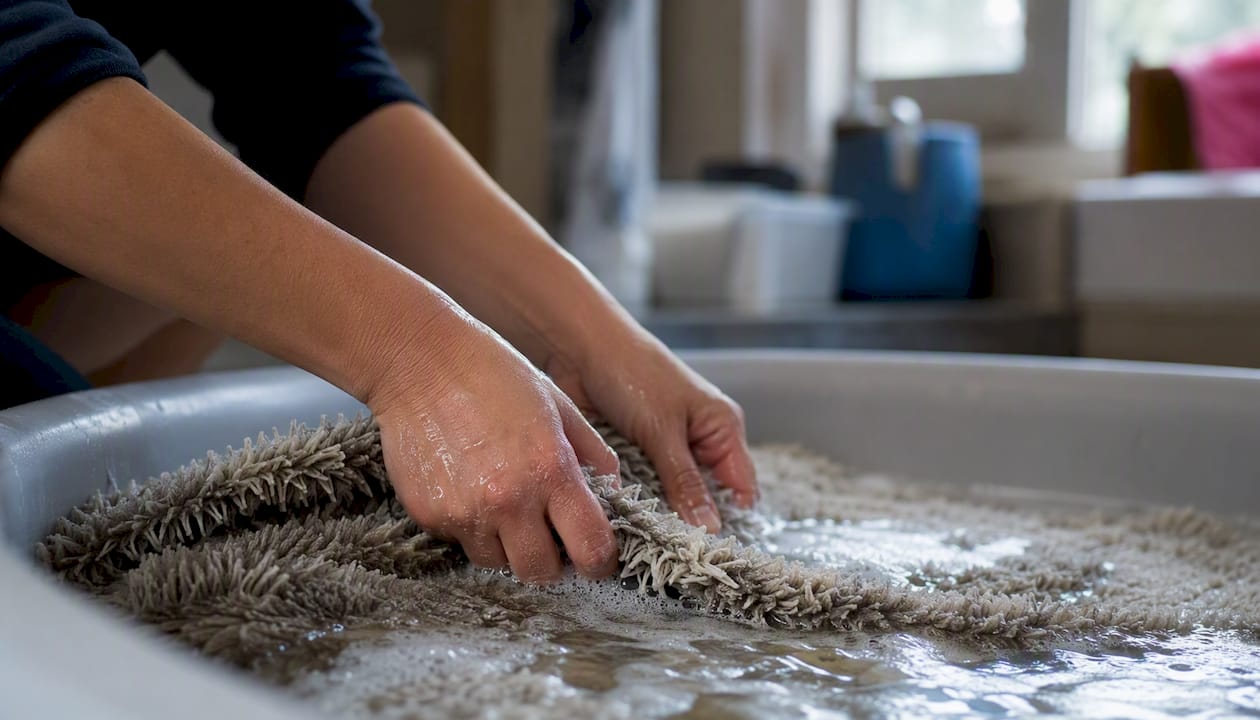
| Method | Best for | What to avoid |
|---|---|---|
| Dry carpet shampoo | Synthetic and wool shag needing a refresh without soaking | Leaving residue in the pile after the dwell time |
| Hand wash outdoors | Small, washable synthetic rugs only | Wool, viscose, or silk rugs of any size |
| Professional wet-clean | Wool, silk, oversized or heavily soiled rugs | Attempting the same process with a rented machine |
Dry-shampoo deep clean, step by step:
- Shake the rug outside and vacuum both sides thoroughly.
- Sprinkle the dry carpet shampoo granules evenly across the pile.
- Work it in gently with a soft brush, following the direction of the fibres rather than against it.
- Leave it for the dwell time stated on the packaging.
- Vacuum thoroughly to remove every trace of residue.
Hand-wash deep clean, for washable synthetics only:
- Shake the rug outside to remove loose debris.
- Vacuum both sides with suction only.
- Lay it flat outdoors and apply a gentle rug shampoo diluted in cool water.
- Work the solution through with a soft brush, following the pile direction.
- Rinse thoroughly with a hose until the water runs clear.
- Press out excess moisture with a squeegee, then roll in dry towels before laying flat to dry.
Do not:
- Use a vacuum’s beater bar at any stage.
- Steam-clean wool or viscose shag under any circumstances.
- Wring the rug or put it in a tumble dryer unless the care label explicitly permits it.
- Skip the care label. Ever.
Pro Tip: If you’re not confident the rug is fully synthetic, treat it as if it’s wool. The cost of being wrong on a natural fibre rug is far higher than the inconvenience of booking a professional clean.
How long does it take a shag rug to dry properly?
Air-dry it flat in the shade with strong airflow, and don’t bring it back indoors until the backing is completely dry. A rug that feels dry on the surface can still be damp underneath, and that’s exactly where mould starts.
Press out as much water as you can first with a squeegee, then roll the rug in dry towels and press firmly to draw out more moisture before you even think about laying it flat. Elevate it on a rack or over a couple of sawhorses where possible, so air moves underneath as well as over the top, and flip it halfway through the drying period. Small rugs can dry within a day in good conditions; larger ones may need two or three days, which is exactly why oversized rugs are trickier to manage safely at home. Drying in shade with elevation and a mid-dry flip prevents the mildew that comes from rushing the process indoors on damp carpet.
- Use a wide-tooth comb or rug rake to fluff the pile once it’s fully dry.
- Work in the direction the fibres naturally sit, not against it.
- For synthetic shag, a very light steam from a garment steamer held a few centimetres away can help lift furniture dents. Never do this on wool or viscose.
- Rotate furniture placement occasionally so the same spots don’t keep flattening.
When should you hire a professional rug cleaner?
Hire a professional when the rug is wool or silk, when it’s too large to dry safely within a day or two, when a stain has already set, or when odour persists after you’ve tried spot cleaning. These are exactly the situations where a DIY attempt is most likely to cause permanent damage rather than fix the problem.
Professionals bring a few things a home kit simply can’t match:
- Controlled wet-cleaning methods safe for wool, silk, and other delicate natural fibres
- Mechanical water extraction and forced-air drying that pulls moisture out of deep pile far faster than towels and a squeegee
- Enzyme treatments strong enough to fully neutralise set-in pet odours
- The ability to repair or reinforce a rug’s backing if it’s been compromised
Before booking, ask a few direct questions: Are the technicians insured? What’s their experience with wool or antique shag specifically? What does the drying process actually involve, and how long will it take? Are the cleaning products eco-friendly and safe if you have kids or pets in the home? A professional cleaning service that answers these clearly, rather than vaguely, is generally the one worth trusting with a valuable rug.
What experience teaches you about DIY versus professional shag rug cleaning
Most shag rugs never need a professional touch. A synthetic shag in a living room, vacuumed weekly and spot-cleaned promptly, will look fine for years on nothing more than dish soap, baking soda, and a rug rake. The mistakes tend to cluster around two situations: wool rugs treated like synthetics, and odour problems treated like stains.
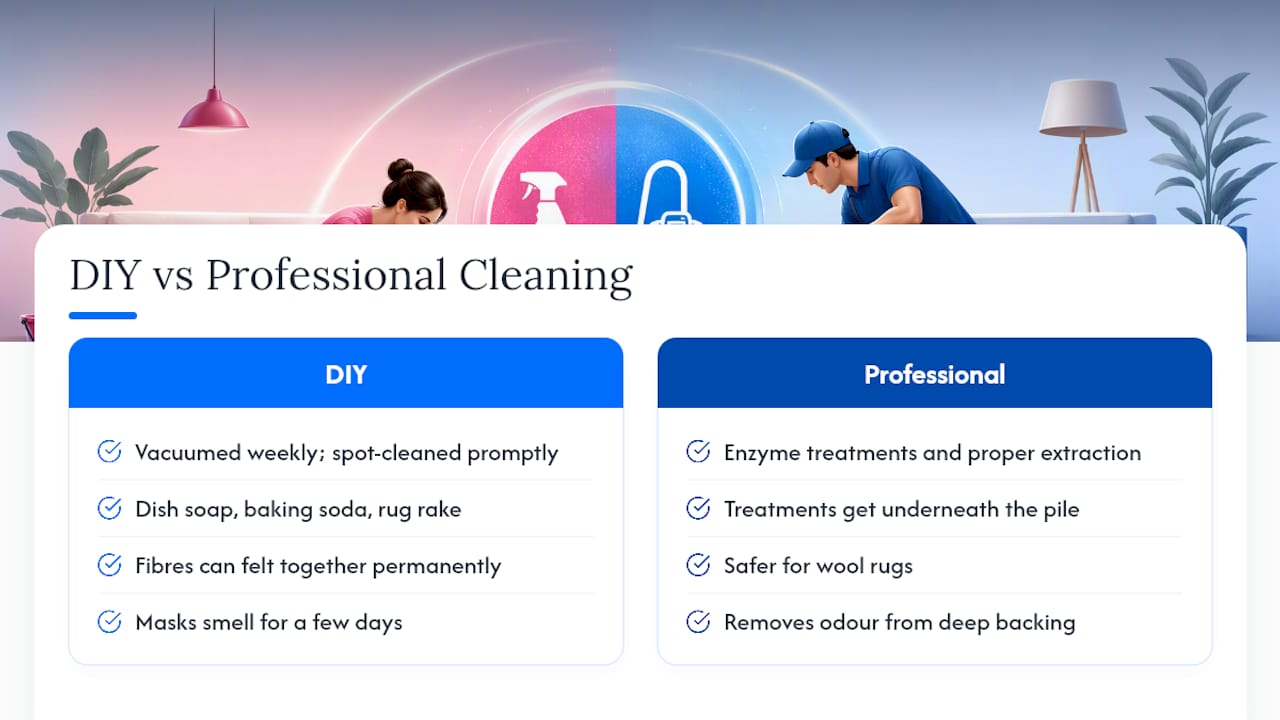
Wool shag punishes overconfidence. Soak it the way you’d soak a synthetic, and the fibres can felt together permanently, turning soft pile into something closer to matted felt that no amount of brushing fixes. Pet odour is the other trap. Surface cleaning masks the smell for a few days, then it comes back, because the source is usually deep in the backing where a squirt bottle can’t reach. That’s not a stubbornness problem, it’s a physics problem. Enzyme treatments and proper extraction solve it because they get underneath the pile, not because they’re stronger detergent.
The rule of thumb worth keeping: if you’re unsure of the fibre, or the rug represents real money or sentimental value, the cost of a professional clean is cheap insurance against a mistake you can’t undo.
Book a professional shag rug clean when DIY isn’t enough
Some jobs are worth doing yourself, and some are worth handing over. When a shag rug is wool, oversized, or carrying a stain and smell that won’t budge with dish soap and patience, Com gives you a controlled wet-clean and forced-air drying process that a rented steamer or a weekend of towel-rolling simply can’t replicate. Our technicians are insured, trained on delicate and natural fibres specifically, and use eco-friendly, chemical-free methods that are safe around kids and pets.

We cover residential rug cleaning alongside our carpet steam cleaning services, and same-day booking is available for straightforward jobs. If your rug has been sitting damp, smelling off, or matted for weeks, get in touch through our Melbourne carpet steam cleaning guide for a quote, or book directly and we’ll walk you through what your specific rug needs before anyone sets foot in your home.
Where to read more on shag rug care
- How to Clean a Shag Rug covers realistic vacuuming and deep-cleaning frequency for everyday households.
- How to Clean a Shag Rug Without Damaging the Pile explains the vacuum technique that protects long shag fibres from tangling.
- How to Clean a Shag Rug Without Matting It breaks down the dry-shampoo method step by step.
- How to Clean a Shag Area Rug: Step-by-Step Guide sets out clear fibre-specific warnings for wool and viscose shag.
- How to Clean a Shag Rug is a solid reference for spot-cleaning sequences on common household stains.
Sources
- How to Clean a Shag Rug
- How to Clean a Shag Rug Without Damaging the Pile | RugKnots
- Buyarearugs
- How to Clean a Shag Area Rug: Step-by-Step Guide
- How to Clean a Shag Rug – Bob Vila
