Don’t Spray Blindly: When to Clean, Sanitize, Disinfect, or Call a Pro
Cleaning removes dirt and germs with soap and scrubbing. Sanitising lowers germs on a surface to a level public health bodies consider safe, mostly aimed at bacteria. Disinfecting kills a broader range of pathogens, including viruses, using registered chemicals left on a surface for a set time. The rule of thumb: clean first, always, sanitise food-contact surfaces like a chopping board, and disinfect only when someone in the house is sick or a surface carries higher risk, such as a doorknob during a stomach bug.
TL;DR:
- Regular cleaning with soap and water removes most germs and dirt, serving as the foundation for effective hygiene routines.
- Disinfecting requires a registered chemical with a specified contact time to kill bacteria, viruses, and fungi, and should follow cleaning.
- Sanitising reduces bacterial levels to safe standards, mainly on food-contact surfaces, but does not kill viruses or spores.
- Overuse of disinfectants on low-risk surfaces can cause damage and unnecessary chemical exposure; target high-touch, high-risk areas instead.
- Professional cleaning is necessary for large-scale contamination, flood damage, or porous surfaces like carpets and upholstery that DIY methods cannot properly treat.
Table of Contents
- Cleaning vs sanitising vs disinfecting: what each word actually means
- When should you clean, sanitise or disinfect?
- How to clean, sanitise and disinfect surfaces properly
- Reading labels and avoiding dangerous mistakes
- When a professional cleaning or sanitisation service makes sense
- Does cleaning, sanitising or disinfecting work better against bacteria, viruses and fungi?
- Who sets the rules for cleaning, sanitising and disinfecting products?
- How temperature and humidity change disinfecting results
- Common myths about cleaning, sanitising and disinfecting
- Why the difference actually matters for public health
- The mistake most people make with cleaning and disinfecting
- Need a deeper clean than a spray bottle can manage?
- Sources
Cleaning vs sanitising vs disinfecting: what each word actually means
The three terms get thrown around interchangeably, and that’s the source of most confusion. They’re not points on a scale where one is just “stronger” than the next. They’re different jobs with different tools.
Cleaning is physical removal. Soap or detergent, warm water, and some elbow grease lift dirt, grease, and a good chunk of germs off a surface. It doesn’t kill anything, technically, but in most household situations cleaning alone removes most germs because the germs go down the drain with the dirt. This is the step everyone skips when they reach straight for a spray bottle, and it’s the one that matters most.
Sanitising reduces germs on a surface to a level public health standards consider safe, and it commonly targets bacteria rather than viruses. It’s the standard for food-contact surfaces, like a cutting board or a bench where you’ve just prepped chicken, because the goal isn’t sterility. It’s keeping bacterial counts low enough that they won’t make anyone sick.
Disinfecting is the heavy hitter. It uses registered chemical products designed to inactivate or kill a broader range of pathogens, including bacteria, viruses, and fungi. Disinfectants are held to more rigorous testing than sanitisers precisely because they’re claiming to do more. Crucially, disinfecting does not remove dirt, which is why it has to come after cleaning, not instead of it.
- Cleaning: removes soil and many germs through physical action, doesn’t kill pathogens directly
- Sanitising: reduces bacteria to a safe public health level, common on food-contact surfaces
- Disinfecting: kills or inactivates bacteria, viruses and fungi using registered chemicals with a required contact time
- Sterilising (worth a mention for context): eliminates all forms of microbial life, a standard reserved for medical instruments and lab equipment, not household surfaces
When should you clean, sanitise or disinfect?
Matching the method to the actual risk saves you time, money, and unnecessary chemical exposure. Here’s how to think about it:
- Everyday living areas (floors, windows, general surfaces): regular cleaning is enough. There’s no health case for disinfecting a coffee table daily.
- Food preparation and infant items (chopping boards, baby bottles, high chairs): clean first, then sanitise. This is where a dishwasher’s hot cycle or a diluted sanitiser solution earns its place.
- Illness in the household or care of vulnerable people: clean, then disinfect high-touch surfaces such as taps, door handles, and toilet flush buttons. This is also where targeted hygiene matters most for older adults or anyone immunocompromised.
- Commercial and healthcare settings: these operate under workplace and health codes that often mandate scheduled sanitising or disinfecting, regardless of visible risk.
- Anywhere else, prioritise by touch frequency. A light switch gets touched fifty times a day; a bookshelf gets touched once a week. Spend your effort where hands actually go.
Experts increasingly push back on the idea that more disinfecting is always safer. A targeted, risk-based approach beats blanket disinfection almost every time, and it’s gentler on your surfaces and your budget.
How to clean, sanitise and disinfect surfaces properly
Getting the method right matters less than getting the sequence right, and the sequence is always the same: clean, then sanitise or disinfect.
Cleaning steps: pick a soap or detergent suited to the surface, use warm water, scrub to physically lift soil, rinse, then dry. Kitchen benches and bathroom surfaces are worth wiping down daily; less-touched areas like skirting boards can stretch to weekly.
Sanitising methods: a dishwasher’s hot rinse cycle sanitises dishes on its own. For manual sanitising, follow the product label or a diluted solution mixed to manufacturer instructions, and rinse food-contact surfaces afterwards if the label calls for it. Food service settings often follow a five-step process (wash, rinse, sanitise, drain, air dry) drawn from workplace food safety codes.
Disinfecting methods: choose a product registered for disinfection, such as a diluted bleach solution or an alcohol-based wipe, and check the label for its exact contact time. This is where most people fail. Spraying and wiping immediately is the single most common mistake in home disinfection, because it doesn’t give the chemical time to work.
- Toys and remote controls: clean regularly, disinfect only if someone’s been sick
- Benchtops after raw meat prep: clean then sanitise
- Soft furnishings and carpet: porous materials trap contaminants that surface wiping can’t reach, which is a genuine limit of DIY disinfecting
Contact time can range from seconds to several minutes depending on the product’s active ingredient, so the label, not habit, should set your timing.
Pro Tip: Keep the surface visibly wet for the full time stated on the label. If it dries out halfway through, you haven’t disinfected it, you’ve just dampened it.
Reading labels and avoiding dangerous mistakes
Every registered sanitiser or disinfectant carries a label with legally required instructions, and skipping it is where most home accidents happen.
- Read the label for the registered claim and the exact contact time before you start
- Never mix bleach with ammonia or acidic cleaners; the combination produces toxic gas that can cause serious injury
- Wear gloves and open a window or door when using disinfectants, and keep products away from children and pets
- Dispose of used wipes in general waste, never down the toilet, since most wipes aren’t flushable
- Store chemicals in their original containers, check expiry dates, and never decant into unlabelled bottles
- Overusing disinfectant on delicate surfaces, like natural stone or some timber finishes, can cause discolouration or damage over time
When a professional cleaning or sanitisation service makes sense
Some jobs go beyond what a bottle of disinfectant and a cloth can fix. Flood damage, large-scale contamination, healthcare and aged care environments, and end-of-lease deep cleans all sit in this category, partly because organic soil blocks disinfectant action if it isn’t fully removed first, something that takes proper equipment to manage across carpet, grout, and upholstery at scale.
A trained provider brings industrial-grade equipment, validated drying processes, and documented protocols that a domestic mop and bucket simply can’t match. Look for these signals before you hire anyone:
- Insured, trained technicians rather than casual labour
- A clear, written scope of work before the job starts
- Eco-friendly or chemical-free methods where appropriate for the setting
- A satisfaction guarantee backing the finished result
For aged care facilities specifically, professional carpet steam cleaning protocols built around infection control standards look very different from a standard residential clean.
Does cleaning, sanitising or disinfecting work better against bacteria, viruses and fungi?
Not every method touches every pathogen equally, and that’s the part most people misunderstand. Cleaning physically removes a wide mix of bacteria, viruses, and fungal spores along with the dirt they’re sitting in, but nothing is guaranteed dead. It’s mechanical removal, not chemical kill.
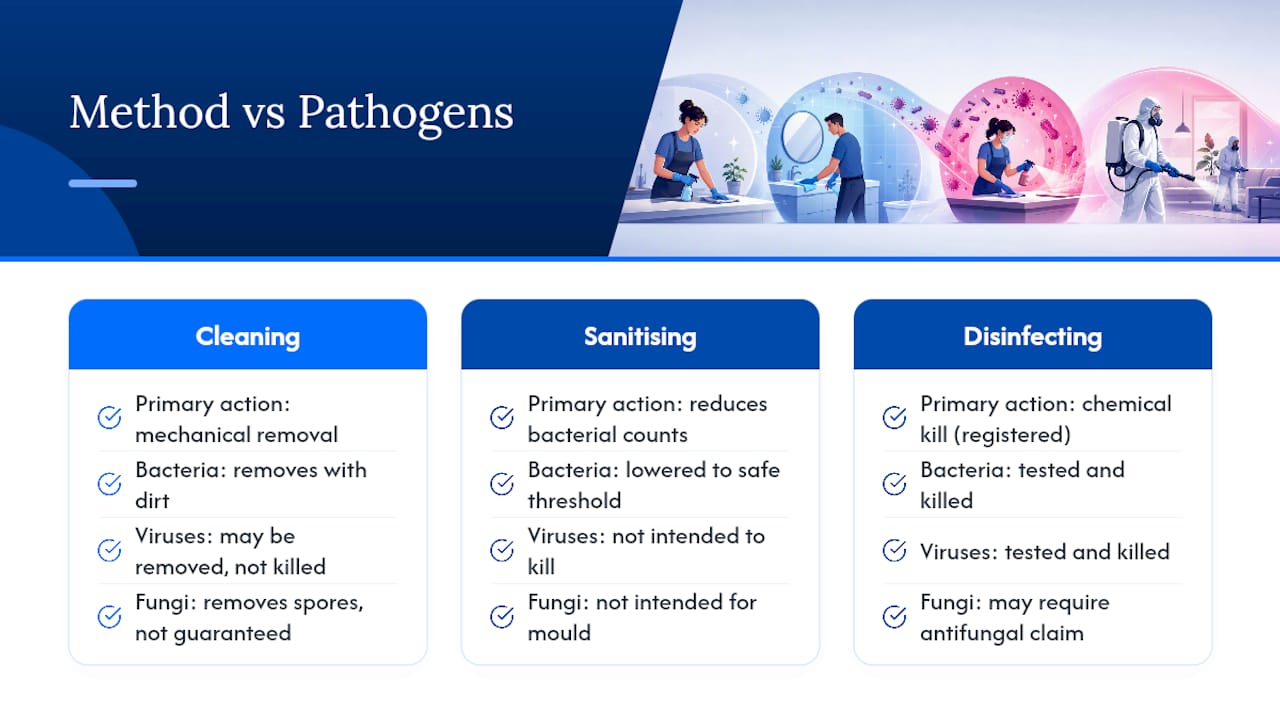
Sanitising is generally calibrated for bacteria. It reduces bacterial counts to a safe threshold but isn’t intended to kill viruses, which is exactly why a sanitising wipe on a kitchen bench and a disinfecting wipe on a sick room doorknob aren’t interchangeable products, even if they look identical on the shelf.
Disinfecting casts the widest net. Registered disinfectants are tested against bacteria, viruses, and in many cases fungi, which is why disinfectant products carry more rigorous regulatory testing than sanitisers. Fungal spores, particularly mould, often need a specific antifungal claim on the label. A general disinfectant won’t necessarily touch them, so if mould is the actual problem, check the label for that exact claim rather than assuming “disinfectant” covers everything.
Who sets the rules for cleaning, sanitising and disinfecting products?
Regulation is where the terms stop being marketing language and start being legally defined categories. In the United States, the Environmental Protection Agency registers disinfectant products and requires efficacy testing before a manufacturer can legally claim a product disinfects. Sanitisers face a separate, generally less stringent registration pathway, and general household cleaners aren’t required to prove any germ-killing claim at all because they aren’t making one.
The American Cleaning Institute frames this as a risk-based hierarchy: clean routinely, sanitise where food or infants are involved, and reserve disinfection for genuinely higher-risk scenarios. Food service settings add another layer entirely, with structured, code-mandated sanitising steps that health inspectors check against.
For an everyday reader, the practical takeaway is simpler than the regulatory detail: if a product’s label doesn’t state a registered sanitising or disinfecting claim, it’s a cleaner, full stop, no matter how it’s marketed on the front of the bottle. Flip it over and check the fine print before you trust it to do more than clean.
How temperature and humidity change disinfecting results
A disinfectant that works brilliantly in a lab test can underperform on your kitchen bench if the room conditions are wrong. Most disinfectant efficacy claims are established at specific temperature ranges, generally room temperature, and colder surfaces slow the chemical reaction that inactivates pathogens. Wiping down a surface in an unheated garage in winter and expecting the same result as a warm kitchen is optimistic.
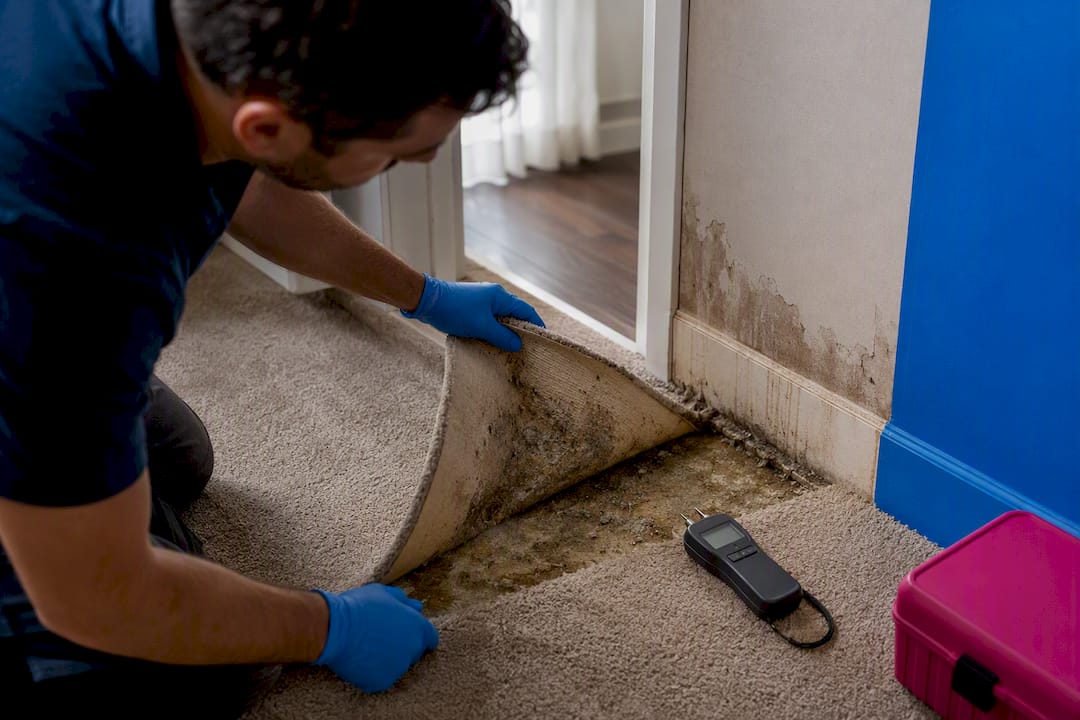
Humidity cuts both ways. Very dry air can cause a disinfectant to evaporate before it hits its required contact time, which undermines the entire process. On the flip side, excess moisture and high humidity create ideal conditions for mould and bacterial regrowth after a clean, particularly in bathrooms and laundries, meaning the same conditions that challenge disinfectant performance also increase how often you’ll need to repeat the process.
This is one reason flood-affected properties are so difficult to manage without professional equipment. Water damage creates sustained high humidity in carpet, underlay, and wall linings, and household-grade dehumidifiers often can’t bring moisture levels down fast enough to stop microbial growth before it takes hold. It’s less about the disinfectant chosen and more about whether the environment lets it actually finish the job it’s designed to do.
Common myths about cleaning, sanitising and disinfecting
“If it smells strong, it’s working.” Bleach smell and lemon scent are not efficacy indicators. Fragrance tells you nothing about whether contact time was met or whether the product is even a registered disinfectant.
“More product means better results.” Beyond the labelled dilution, extra concentration doesn’t buy extra kill power, it just raises the risk of surface damage and chemical exposure. Manufacturers test at specific ratios for a reason.
“Vinegar disinfects.” Vinegar is a mild cleaning acid, useful for cutting grease and mineral buildup, but it isn’t registered as a disinfectant and hasn’t been tested to the same standard. Treat it as a cleaner, nothing more.
“Sanitising and disinfecting are the same thing, just different brand names.” They’re regulated separately, tested against different pathogen ranges, and built for different risk levels. Using them interchangeably in a household with an unwell family member can leave you under-protected.
“You should disinfect everything, all the time.” This is arguably the most damaging myth. Daily blanket disinfection of low-risk surfaces adds unnecessary chemical exposure without a meaningful health benefit, and it can accelerate wear on delicate materials.
Why the difference actually matters for public health
Hygiene protocols in hospitals, aged care, and food service aren’t built around one universal “clean everything hard” instruction. They’re built around matching the intervention to the actual infection risk, and getting that wrong in either direction causes real harm.
Under-treating a high-risk surface, a shared bathroom during a gastro outbreak, a nappy change table, a doorknob in a household with a contagious flu, lets pathogens persist and spread. Over-treating low-risk surfaces wastes resources, increases chemical exposure for children and pets, and in commercial settings can contribute to antimicrobial resistance concerns tied to overuse of certain active ingredients.
Public health guidance increasingly frames this as targeted hygiene: identify the surfaces and moments that carry genuine transmission risk, hands, high-touch points, food-contact areas, and concentrate sanitising and disinfecting effort there, while relying on regular cleaning everywhere else. This is the model behind most workplace hygiene codes and the reasoning health authorities recommend for households managing everyday risk without over-relying on chemicals. Get this balance right, and infection control becomes something you sustain, not something you burn out trying to maintain.
The mistake most people make with cleaning and disinfecting
The biggest failure in home hygiene isn’t a lack of effort, it’s misdirected effort. People reach for the strongest chemical in the cupboard when a $2 bottle of dish soap and some scrubbing would do the job just as well, and they skip the boring cleaning step entirely when they’re worried about germs, which is exactly backwards. Disinfectant sprayed onto a greasy, soiled surface is mostly wasted, because the soil blocks it from ever reaching the pathogens underneath.
Conventional advice tends to oversell disinfecting as the “serious” option and undersell cleaning as the “basic” one. In practice, cleaning is doing most of the actual work in a typical home, and disinfecting is a targeted tool for a narrow set of higher-risk moments, not a daily default. The households that manage this well aren’t the ones with the most spray bottles under the sink. They’re the ones who’ve internalised the sequence: clean always, sanitise where food and infants are involved, disinfect when illness or genuine risk shows up, and skip the theatre the rest of the time. If there’s one thing worth changing today, it’s dropping the instinct to disinfect first and clean later. Reverse that order and everything downstream works better.
— Roney
Need a deeper clean than a spray bottle can manage?
Some jobs sit outside what household cleaning or disinfecting can realistically fix, and carpet, grout, and upholstery are usually where DIY efforts hit their limit. Com handles deep sanitisation across carpet steam cleaning, tile and grout sanitisation, and flood damage restoration, using trained, insured technicians and eco-friendly, chemical-free methods that get into the layers a surface wipe never reaches.
Porous materials trap soil and microbial matter well below what a disinfectant wipe can touch, which is exactly why professional carpet upholstery cleaning exists as its own category rather than an extension of home cleaning. Aged care and healthcare properties in particular need documented sanitisation protocols that go beyond what a general clean provides, while flood-affected homes need equipment capable of managing the humidity that lets mould take hold long after the water’s gone. If your situation involves water damage, a large-scale contamination, or a scheduled deep sanitisation for a high-risk property, book a Melbourne carpet steam cleaning service and check current availability. Every job comes with a satisfaction guarantee, so you know exactly what you’re getting before the crew arrives.
Sources
- Cleaning and disinfecting | CDC
- What’s the difference between products that disinfect, sanitize, and clean surfaces? | US EPA
- Cleaning and disinfecting | MedlinePlus
- What is the difference between cleaning, disinfecting and sanitizing? | American Cleaning Institute
