Ink Stain: Safe First Minute Fixes for Melbourne Carpet
Blot the ink immediately with a dry white cloth, working from the outside of the stain toward the centre so you don’t spread it further. Test any cleaner on a hidden patch of carpet before you touch the stain itself. Most fresh ink lifts with patience and the right solvent, but if the carpet is wool, the ink is toner, or a few attempts haven’t worked, stop and call a professional before you make things worse.
TL;DR:
- Wet ink that has already spread into padding requires professional extraction tools, especially if toner or old stains are involved.
- Alcohol-based solvents like isopropyl or methylated spirits are effective on ballpoint ink, but over-saturation risks damaging the carpet fibers.
- Water-based markers and gel pens respond best to cool water mixed with mild dish soap, while permanent markers often only lighten with repeated solvent applications.
- Household remedies such as hydrogen peroxide or baking soda paste can help lift residual pigment but must be tested on a hidden area first to avoid discoloration.
- Call a professional when the stain is set in for days, involves high-value or wool carpet, or after multiple unsuccessful DIY attempts to prevent further damage.
Table of Contents
- What type of ink is it, and why does that matter?
- How do you stop a fresh ink spill from spreading?
- Which cleaning method works for each ink type?
- What if the ink stain has already dried or set in?
- When should you call in a professional carpet cleaner?
- How do you stop ink stains from happening again?
- A professional’s take on where DIY should stop
- Get a professional finish when home methods hit their limit
- Sources
What type of ink is it, and why does that matter?
Not all ink behaves the same way once it hits carpet fibre, and treating the wrong type with the wrong product is how a coin-sized mark becomes a permanent one. Ballpoint ink is oil-based and needs a solvent to break down. Gel pens and washable markers are usually water-based, so detergent and cool water do the job. Permanent marker sits somewhere in between and often only partially lifts no matter what you use. Printer toner isn’t really “ink” at all. It’s a dry thermoplastic powder that only becomes a real problem once it meets water or heat.
A few quick checks help you work out what you’re dealing with:
- Smudges when you touch it dry? Likely toner or loose pigment, not wet ink. Vacuum first, don’t wipe.
- Smells faintly chemical and feels slightly oily on a cloth? Probably ballpoint, which calls for isopropyl alcohol or methylated spirits.
- Comes off partly on a damp cloth? Likely water-based gel or washable marker.
- Barely moves under any pressure at all? Probably permanent marker, and your expectations should adjust accordingly.
Before applying anything, dab a small amount on an inconspicuous corner of carpet and wait a few minutes to check for colour bleed or fibre damage. Some hairsprays, often suggested as a home fix, actually leave behind resins that attract more soil rather than lifting the stain cleanly, so skip that one unless you’ve confirmed the formula is alcohol-heavy.
How do you stop a fresh ink spill from spreading?
Speed matters more than technique in the first sixty seconds. Wet ink that sits will keep migrating outward and downward into the padding, so the goal is containment first, cleaning second.
- Keep foot traffic off the area and grab white paper towels or a clean white cloth, plus gloves if you’re using any solvent.
- Press, don’t wipe. Lay a folded paper towel over the wet ink and press straight down, lifting once it’s saturated and replacing with a fresh dry section.
- Repeat this layering process, always working inward from the edge, until the cloth stops picking up colour.
- Only once the bulk of the wet ink is absorbed should you introduce a cleaning agent, and even then use it sparingly, applied to the cloth rather than poured onto the carpet.
Pro Tip: Never rub the stain in circles. Rubbing pushes ink sideways into clean fibre and drives it deeper into the pad, which is exactly what patient blotting is designed to avoid.
The Carpet and Rug Institute’s own guidance backs this up: keep blotting with a dry white cloth and continue using the same agent while it’s still transferring colour, rather than switching products halfway through. Mixing cleaners is one of the more common ways a fixable stain turns into a bigger one, since some combinations react and leave discolouration of their own.
Which cleaning method works for each ink type?
Once the wet ink is under control, match the treatment to what you identified earlier.
- Ballpoint pen: Dampen a cloth (not the carpet) with isopropyl alcohol at 70% or higher, or methylated spirits. Blot, don’t scrub, and switch to a clean section of cloth as soon as colour transfers. Denatured alcohol dries fast and penetrates ballpoint ink well, but it can also over-saturate padding if you’re heavy-handed, so use small amounts and reapply rather than soaking the spot once.
- Water-based markers and gel pens: Mix a few drops of mild dishwashing liquid into cool water. Warm or hot water can set some dyes permanently, so cool is non-negotiable here. Blot the solution in, then rinse with a separate damp cloth.
- Permanent marker: Treat this one as damage control rather than a guaranteed fix. Small, repeated applications of solvent with plenty of blotting in between will often lighten the mark considerably, but a full disappearance isn’t realistic in most cases.
- Printer toner: Vacuum thoroughly before anything else touches it. If the toner has already been wetted, mopped, or steamed, stop immediately. Heat and moisture fuse the plastic powder into carpet fibre, and at that point a household approach usually can’t undo it.
Home remedies get suggested a lot, and a couple genuinely help: hydrogen peroxide can lift ink from white carpet (never coloured, as it can bleach), and a baking soda paste left to dry and then vacuumed can pull out residual pigment from a partially treated spot. WD-40 sometimes breaks down old ballpoint ink but leaves an oily residue that needs its own detergent clean-up afterwards, so treat it as a last resort rather than a first choice.
Whatever method you use, rinse the area multiple times with cool water and blot dry between passes. Solvent residue left in the fibre acts like a magnet for dust and dirt, so a stain that looks gone today can reappear as a grey shadow within weeks if you skip this step. Professional cleaners group treatments this same way, matching solvent to ink chemistry rather than treating every mark the same, which is a big part of why targeted approaches outperform generic “carpet cleaner” sprays.
What if the ink stain has already dried or set in?
Ink that’s had days or weeks to sit behaves differently to a fresh spill. It’s had time to bond with the dye in the carpet fibre, not just sit on the surface, and that chemical change is why household solvents that work on a fresh mark often only fade an old one.
- Controlled chemical reduction, essentially a mild oxidising treatment, can lift pigment from set-in marker stains, but the Carpet and Rug Institute notes this carries a real risk of stripping the carpet’s own dye along with the ink.
- Always test this kind of treatment on a hidden section first, since a visible patch of faded carpet is often worse than the original stain.
- Large-area stains, or ones on wool or a carpet you can’t identify with confidence, are where DIY should stop.
- Sometimes the honest outcome is a localised repair, a dye correction, or in rare cases a small carpet patch, rather than a full stain removal.
When should you call in a professional carpet cleaner?
A few situations call for a professional rather than another home attempt. Unknown fibre types, especially wool, react unpredictably to solvents. Toner that’s already been wetted is a job for specialised equipment, not a spray bottle. Two or three failed treatments on the same spot, or a stain covering a large or high-value area, are also good reasons to stop.
Professionals bring tools most households don’t have: wet and dry extraction units, sealed-filtration vacuums that won’t scatter fine toner particles, and controlled solvent application that avoids the over-wetting risk that ruins padding. A reputable technician will tell you upfront when a stain can be improved but not fully erased, which is a more useful answer than a guarantee that never holds up.
| Situation | Home DIY suitable? | Better handled by a professional |
|---|---|---|
| Fresh ballpoint or gel pen, small area | Yes | Not usually needed |
| Toner already wetted or heated | No | Yes, sealed-filtration extraction required |
| Wool carpet, any ink type | Caution | Yes, fibre-safe solvents needed |
| Set-in stain over 1 week old | Limited success | Yes, for dye-safe reduction |
| Large area or multiple failed attempts | No | Yes |
How do you stop ink stains from happening again?
A little routine prevention beats another round of solvent and blotting. Keep pens capped and stored in a drawer rather than loose on a desk near carpet, and check jacket and school uniform pockets before laundry day, since a leaking pen in a pocket is a common cause of surprise stains. If kids are doing art projects, a cheap mat or rug under the activity saves the carpet underneath entirely.
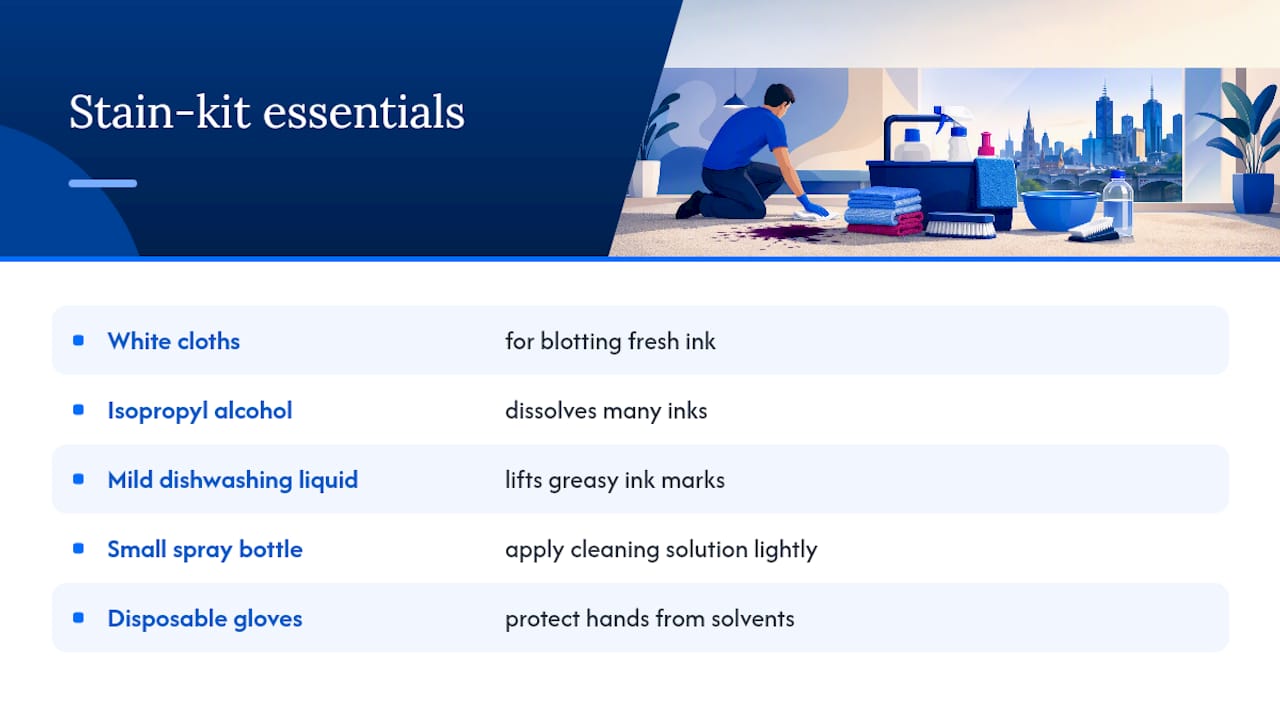
A basic stain kit is worth keeping on hand: white cloths, isopropyl alcohol, a mild dishwashing liquid, a small spray bottle, and disposable gloves. Having these ready means you can act in the first minute rather than searching cupboards while ink sets deeper.
A professional’s take on where DIY should stop
Most home ink treatments fail not because the method is wrong, but because people rush the rinse step or reach for a second product before the first one has finished working. Patience and switching to a clean cloth section, rather than aggressive scrubbing, is genuinely the difference between a stain that fades out and one that spreads.
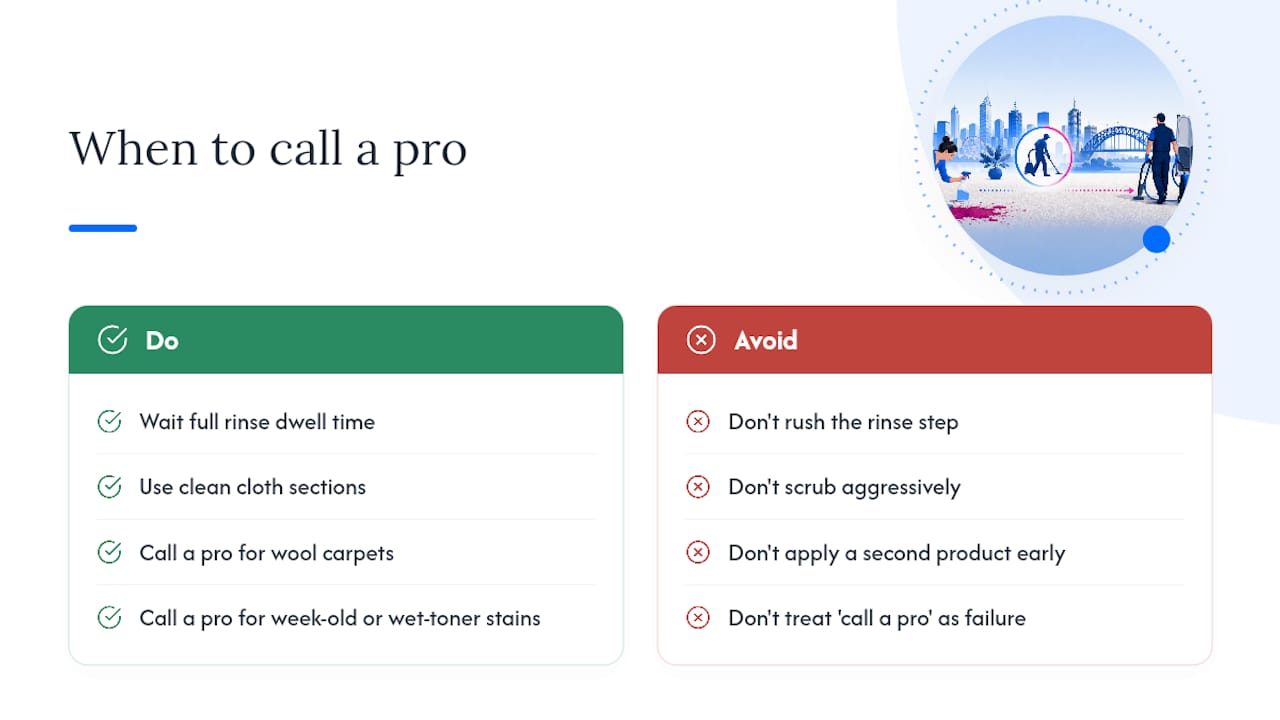
Where I’d push back on the usual advice: too many guides treat “call a professional” as an admission of failure, when really it’s a decision point built into the process from the start, not a last resort after everything else has gone wrong. Wool carpet, toner that’s already wet, and stains that have had a week to bond with the dye are cases where the right call is often the first call, not the fifth attempt.
At Com, we see plenty of carpets where a DIY effort has improved things but left a faint shadow or a slightly stiff patch from over-wetting. Our carpet steam cleaning services use eco-friendly, chemical-free methods and trained, insured staff, which matters when a stain has already had a few rounds of home chemicals thrown at it. Same-day options and satisfaction guarantees exist because sometimes the honest answer to “can this come out” only becomes clear once proper equipment is involved.
— Roney
Get a professional finish when home methods hit their limit
Com is the practical next step when blotting, alcohol, and detergent have taken the stain as far as they can. Where a DIY attempt risks over-wetting the pad or fading the carpet’s own dye, our steam cleaning uses eco-friendly, chemical-free methods delivered by trained and insured technicians, with the extraction equipment a spray bottle simply can’t match.

This suits homeowners dealing with a stubborn or set-in mark, renters facing an end-of-lease inspection with a stain still visible, and anyone with wool carpet who doesn’t want to risk a solvent test gone wrong. If you’re moving out, our guide on how to move out clean covers what inspectors actually check. For a broader clean beyond the one stained patch, our Melbourne carpet steam cleaning guide explains what to expect from a full visit. For those wanting a stepwise mindset before booking, this bed bug removal guide from a trusted partner shows the same test-first, methodical approach that carries over well to ink treatment.
If the mark is still sitting there after your own attempts, get a carpet steam cleaning quote in Melton or reach out through our main site to book a same-day assessment.
Sources
- Ink, Permanent – The Carpet and Rug Institute
- How to Remove Ink From Carpeting or a Rug | HGTV
- How Do You Get Ink Out of Carpet? Try These Expert Tips | COIT
- How to Remove Ink Stains from Carpet | Three North Clean
