How to remove candle wax from carpet safely
Freeze it, scrape it, lift the residue with controlled heat, then treat any remaining dye. That four-step sequence, backed by standard household guidance, handles most candle wax spills on carpet without damaging the fibres. Call a professional if the wax has soaked through to the underlay or backing, if the dye stain persists after two attempts, or if you have wool or loop-pile (Berber) carpet and are unsure about heat limits.
Quick rescue for a fresh spill:
- Stop. Do not wipe or blot warm wax.
- Place a sealed bag of ice or frozen vegetables directly on the spill.
- Wait until the wax is fully hard before touching it.
- Then follow the step-by-step method below.
Pro Tip: Never wipe warm wax. Professionals confirm that wiping pushes wax deeper into the pile and backing, turning a surface spill into a much harder problem.
Key takeaways
Removing candle wax from carpet safely requires hardening the wax first, then scraping, lifting residue with controlled heat, and treating dye with isopropyl alcohol or an oxy-based cleaner before calling a professional if the underlay is affected.
| Point | Details |
|---|---|
| Freeze before you scrape | Harden wax with a sealed ice bag before touching it; warm wax pushed deeper is harder to remove. |
| Match heat to fibre type | Use a hair dryer instead of an iron on polypropylene or polyester to avoid fusing the pile. |
| Treat dye separately | Blot with isopropyl alcohol from outside in; use oxy paste for colourfast carpets, hydrogen peroxide for white only. |
| Know when to stop DIY | Call a professional when wax has reached the underlay, dye persists after two attempts, or carpet is wool or loop-pile. |
| Rony’s Carpet Steam | Professional inspection and steam cleaning across Melbourne suburbs, with honest advice on what is and is not fixable. |
Table of Contents
- What do you need before you start cleaning?
- How to remove candle wax from carpet step by step
- How do you treat coloured candle dye stains?
- What mistakes make candle wax stains worse?
- When should you call a professional cleaner?
- How do professionals safely remove wax and dye?
- What I’ve seen from years of cleaning Melbourne carpets
- Melbourne’s professional wax removal service
- Sources
What do you need before you start cleaning?
Gather everything before you begin. Stopping mid-clean to hunt for supplies gives the wax time to set further into the fibres.
Tools and materials (all available in Australia):
- Ice cubes or frozen vegetables in a sealed zip-lock bag
- Dull butter knife, old credit card, or plastic scraper
- Vacuum cleaner
- White paper towels or clean white cotton cloths (coloured cloths can transfer dye)
- Iron (set to low, no steam) or a hair dryer
- Rubbing (isopropyl) alcohol, available from chemists such as Chemist Warehouse or Priceline
- Oxygen-based spot cleaner (Oxi-type powder or spray, sold at Woolworths, Coles, and Bunnings)
- Hydrogen peroxide 3% solution, for white carpet only
Oxi-type powders (such as Vanish Oxi Action) are on supermarket shelves nationwide.
Pro Tip: Before applying any solvent, do a spot test on a hidden section of carpet, such as inside a wardrobe or behind a door. Dampen a white cloth with the product, press it to the carpet for 30 seconds, then check the cloth for colour transfer. If colour comes off, stop and call a professional.
To identify your carpet fibre, check the label attached to the gripper rod at the edge of the room, or contact the retailer or builder who installed it. Fibre type determines how much heat is safe to use.
How to remove candle wax from carpet step by step
This method works for most household spills on synthetic and blended carpets. Allow enough time for the wax to harden and be removed, which may range from around half an hour for small spills to longer for larger areas.
Step 1: Harden the wax (5–10 minutes)
Place a sealed bag of ice directly on the wax. The goal is to make it brittle enough to shatter rather than smear. Do not press down. Once the wax feels solid and cold to the touch, move to the next step.
Step 2: Scrape and vacuum (5 minutes)
Use a dull knife, old credit card, or plastic scraper held at a low angle. Work from the outer edge of the spill toward the centre to avoid spreading it. Lift the broken pieces rather than dragging them. Vacuum up the loose flakes immediately.
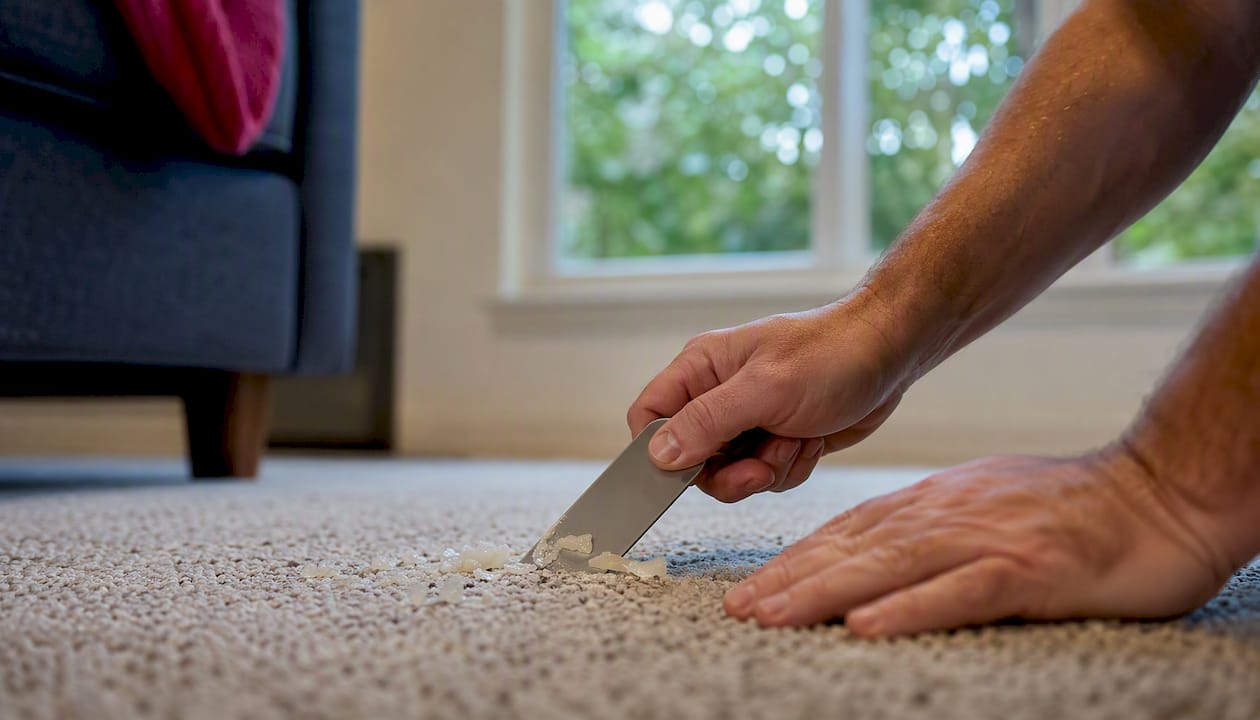
If you have a loop-pile (Berber) carpet, be especially gentle here. Aggressive scraping can fray the loops, and once a loop pulls, it is difficult to reverse. Use your fingernails or a very light touch with a plastic card. If fibres look fuzzy after scraping, a careful trim with flat scissors can even up the pile.
Step 3: Heat transfer to lift oily residue (10–20 minutes)
Lay two or three sheets of white paper towel over the remaining wax residue. Set an iron to its lowest setting with the steam function switched off. Press the iron gently onto the paper towel for 10–15 seconds, then lift. The heat re-melts the wax and the paper towel absorbs it. Move to a clean section of towel each time so you are not re-depositing wax.
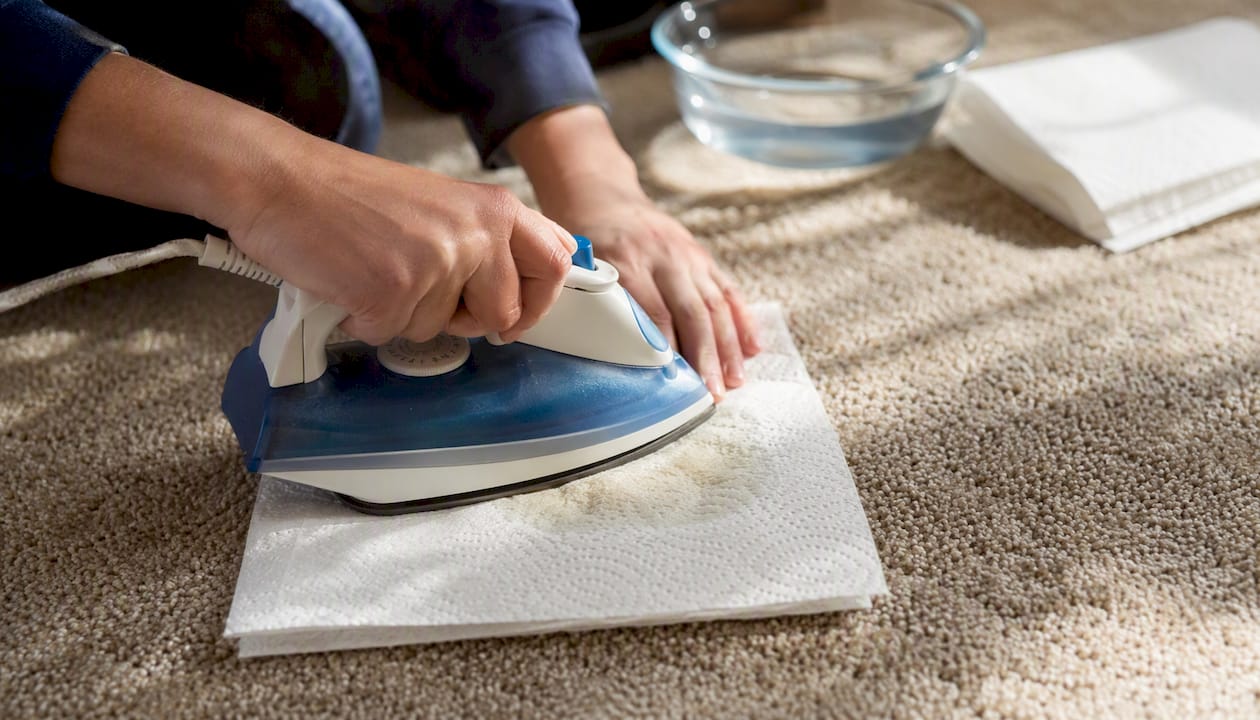
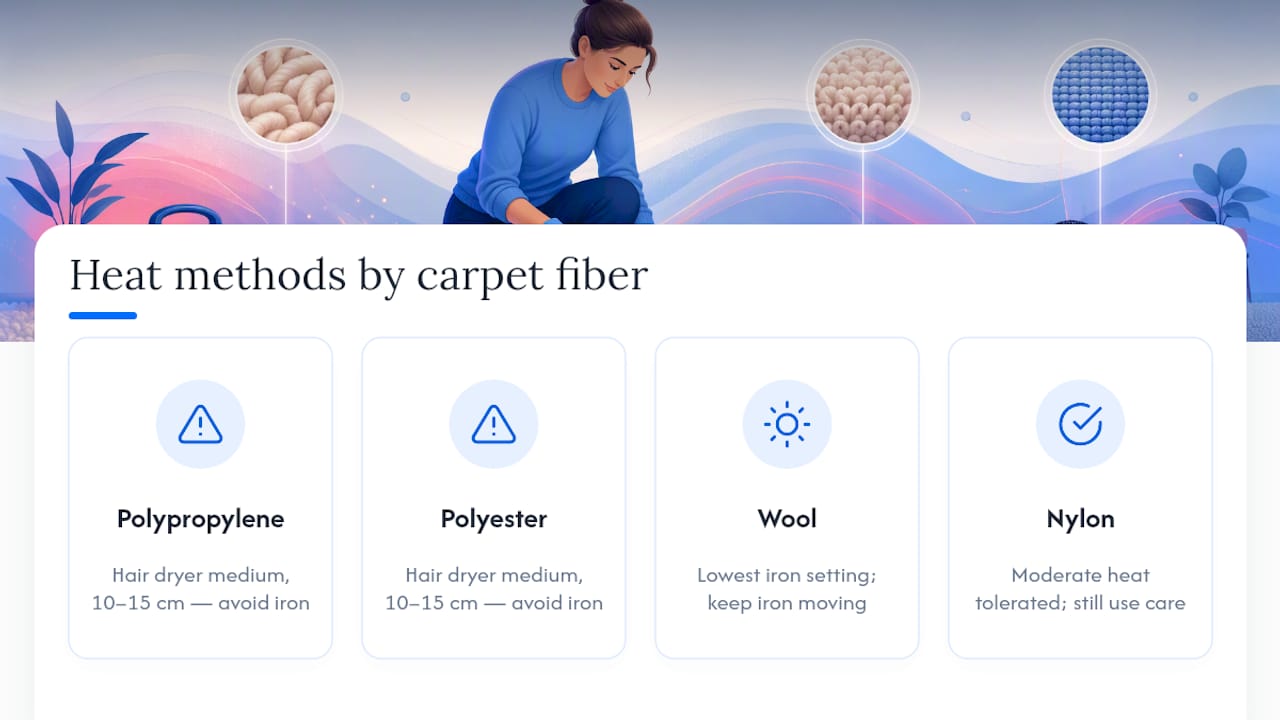
Fibre type matters here. Polypropylene and polyester can distort or fuse under concentrated heat, so use a hair dryer on a medium setting held 10–15 cm above the towel instead of an iron for those fibres. Wool carpet is heat-sensitive too; keep the iron moving and use the lowest setting. Nylon handles moderate heat better than polypropylene but still warrants care.
Pro Tip: Soy wax stays liquid longer than paraffin and carries more fragrance oil, so it often leaves a greasier residue. After the heat-transfer step, treat the area with a small amount of dish soap diluted in cold water, blot, then rinse with a damp cloth before moving to the cleaning step.
Step 4: Clean remaining residue (5–10 minutes)
Blot from the outside of the stain inward using a clean white cloth. Never scrub. Rinse by blotting with a damp cloth, then press dry paper towels onto the area and leave for 10 minutes. This four-step approach resolves most common household spills.
Allow the carpet to dry fully before walking on it. Point a fan at the area or open a window to speed drying and prevent moisture reaching the underlay.
How do you treat coloured candle dye stains?
Removing the wax is one thing. The dye a coloured candle leaves behind is a separate problem, and it needs a different approach.
Isopropyl alcohol (first choice for most carpets)
Dampen a clean white cloth with isopropyl alcohol and blot the stained area, working from the outer edge inward. Do not rub. The alcohol loosens the dye from the fibres without the bleaching risk of peroxide. Always test for colourfastness first on a hidden section. Repeat the blotting with a fresh part of the cloth each time until no more colour transfers.
For coloured stains and dye removal that mirrors the candle wax problem, the same blot-from-outside-in principle applies regardless of the stain source.
Oxygen-based bleach paste (for colourfast, non-wool carpets)
Mix an oxygen-based powder (Vanish Oxi Action or similar) with just enough cold water to form a paste. Apply it to the dye stain, leave for 10–15 minutes, then vacuum away the dried residue. Do not use this on wool carpet; the alkalinity can damage wool fibres.
Hydrogen peroxide (white carpet only)
Leave for five minutes, then blot with cold water. This is a mild bleaching agent and will lighten or remove colour from non-white carpet, so restrict it strictly to white or off-white pile.
Pro Tip: Vinegar is not effective on candle wax dye. It works on alkaline stains and odours, but wax dye does not respond to mild acid. Stick with isopropyl alcohol or an oxy-based product.
If the dye stain has not shifted after two full attempts with isopropyl alcohol, stop. Repeated solvent application risks stripping the carpet’s own colour. That is the point to call a professional.
What mistakes make candle wax stains worse?
A few common errors turn a fixable spill into a permanent problem.
Wiping warm wax is the most damaging mistake. The wax is still liquid enough to be pushed further into the pile and backing, where it sets in a layer that home methods cannot reach. Wait for it to harden completely.
Using WD-40 or other oil-based sprays introduces a new problem. These products leave an oily residue that is harder to remove than the original wax and can affect carpet backing and adhesives. Stick to the products listed above.
Excessive heat on polypropylene or polyester can melt or fuse the fibres, creating a shiny, matted patch that no cleaning will fix. If you are not certain of your carpet’s fibre type, use a hair dryer rather than an iron.
Over-wetting the carpet risks saturating the underlay and the floorboards beneath. Use minimal liquid at each step, blot rather than pour, and allow full drying time between applications. For oil-based residues that linger after wax removal, the same minimal-moisture principle applies.
Spot-test every solvent on a hidden section of carpet before applying it to the stain. A 30-second test prevents a permanent mistake.
When should you call a professional cleaner?
DIY works well for small, surface-level spills. Several situations call for professional help.
Call a professional when:
- The wax has soaked through the pile to the underlay or backing.
- The dye stain has not shifted after two attempts with isopropyl alcohol.
- The carpet is wool, silk, or a delicate loop-pile weave.
- The spill covers a large area (roughly larger than an A4 sheet).
- You have already tried DIY and the stain looks worse.
If wax has penetrated to the underlay, domestic methods are unlikely to remove it fully. Oily residue in the underlay wicks back up through the pile over time, and the only reliable fix is commercial hot-water extraction or, in severe cases, underlay replacement.
A professional inspection identifies whether the underlay or backing is contaminated and determines whether in-place cleaning will work. For Melbourne homeowners, a professional carpet steam cleaning visit typically includes an initial assessment before any work begins.
Pro Tip: Always ask for a written quote before work starts. Reputable services will inspect the stain, identify the fibre type, and give you a clear scope of work before charging anything.
A professional inspection is not a commitment to a full clean. It is an assessment that tells you exactly what is and is not fixable — and that information alone is worth the call.
How do professionals safely remove wax and dye?
Professional carpet cleaners follow a structured process that goes beyond what household tools can achieve.
Typical professional service steps:
- Assessment: Identify fibre type, stain depth, and whether the underlay is affected.
- Containment: Protect the subfloor and surrounding carpet from solvent or moisture spread.
- Controlled heating or solvent application: Commercial spotters formulated for wax and dye, applied at safe concentrations for the specific fibre.
- Hot-water extraction: Adjustable temperature extraction that re-melts and flushes wax residue from the full pile depth without spreading it into the underlay.
- Dye treatment: Targeted application of professional-grade dye removers where needed.
- Post-clean inspection and pile restoration: Grooming the pile back to its original direction and checking for any remaining residue.
The key advantage professionals hold is equipment calibration. Commercial hot-water extraction can re-melt and move wax if used incorrectly; trained technicians adjust water temperature and extraction technique to avoid pushing residue deeper. They also carry commercial spotters not available in supermarkets, and they know the heat thresholds for each fibre type without guessing.
For set-in stains that have been through multiple DIY attempts, professional extraction often achieves results that home methods cannot, though permanently dyed or melted fibres have limits no cleaning can overcome.
Pro Tip: Ask the technician to identify your carpet fibre before they start. A good professional will do this automatically; if they don’t, it is a reasonable question to ask.
Professional results depend on fibre type, stain age, and whether the underlay is affected. Honest services will tell you upfront when a stain is beyond full recovery — that transparency is a sign of a trustworthy operator.
For family-safe cleaning approaches that minimise chemical exposure during stain treatment, the same principle of minimal-solution, targeted application applies whether you are doing it yourself or briefing a technician.
What I’ve seen from years of cleaning Melbourne carpets
Most candle wax calls we receive are small drips from a dinner table candle that tipped over. Those cases almost always return to near-normal with the freeze-scrape-heat method, even when the homeowner panicked and wiped the warm wax first. The damage from wiping is real, but it is rarely catastrophic for a small spill.
The harder cases are large overturned candles, particularly soy wax candles, which stay liquid longer and carry fragrance oils that penetrate deeper. When a full jar candle tips onto a light-coloured carpet and sits for even a few minutes, the dye and oil combination can reach the underlay. At that point, DIY is unlikely to get you back to a clean result.
The most practical thing you can do to avoid repeat incidents is to place candles on hard surfaces with a tray underneath, never directly on carpet or on a surface that overhangs carpet. Prevention takes about five seconds. Remediation can take an hour or more, and sometimes it still leaves a trace.
Melbourne’s professional wax removal service
When DIY has reached its limit, Rony’s Carpet Steam offers professional spot treatment and carpet steam cleaning across Melbourne suburbs, with trained, insured technicians who assess the stain before any work begins.

The service covers spot treatment for wax and dye stains, controlled hot-water extraction calibrated to your carpet’s fibre type, underlay inspection, and end-of-lease cleaning where a wax stain needs to be resolved before a property inspection. Eco-friendly, chemical-free methods are used throughout.
One honest note: permanently dyed or heat-fused fibres have limits that no cleaning can reverse. The team will tell you that upfront after the inspection rather than charge for a result they cannot deliver.
To book an inspection or get a quote for your Melbourne property, visit Carpetsteammelbourne.
Sources
- How to remove wax from a carpet
- How to Get Candle Wax Out of the Carpet in 4 Easy Steps
- Removing Candle Wax From Carpet Without Damaging the Fibres | Stain Kings Manchester
- How to get wax out of carpet
- The best ways to remove spilled candle wax from carpet and upholstery | Lifehacker
