Expert Guide to Red Wine Stain Removal from Carpet: Melbourne Edition
You’re hosting a dinner party in Melbourne when a glass of Shiraz tips over, sending a deep crimson wave across your light-coloured flooring. The immediate panic is real. You worry about a permanent eyesore in the lounge or losing your bond if you’re renting. It’s a common household crisis, and the conflicting advice online about salt or vinegar only adds to the stress. We understand that red wine stain removal from carpet isn’t just about cleaning; it’s about protecting your home’s value and your peace of mind.
This guide empowers you to take control of the situation before the pigment binds to the fibres. You’ll master the exact, professional-approved steps to lift the spill immediately using safe, family-friendly methods. We’ll also clarify when DIY efforts aren’t enough and why professional hot water extraction is the only way to prevent “ghost” stains from resurfacing later. From immediate first aid to knowing when to call a Melbourne specialist, you’re about to become an expert in saving your carpets from the toughest spills.
Key Takeaways
- Act immediately to prevent chromogens and tannins from permanently dyeing your carpet fibres as they settle.
- Master the “blot, don’t rub” technique for effective red wine stain removal from carpet to stop the spill from spreading.
- Identify whether you have wool or synthetic flooring to choose the correct pH-neutral cleaning agents for Melbourne homes.
- Avoid DIY hacks like salt or harsh chemicals that can lead to permanent bleaching or the frustrating “wicking” effect.
- Use professional hot water extraction as a fail-safe method to ensure complete pigment removal and protect your rental bond.
The Chemistry of a Spill: Why Red Wine Stains So Fast
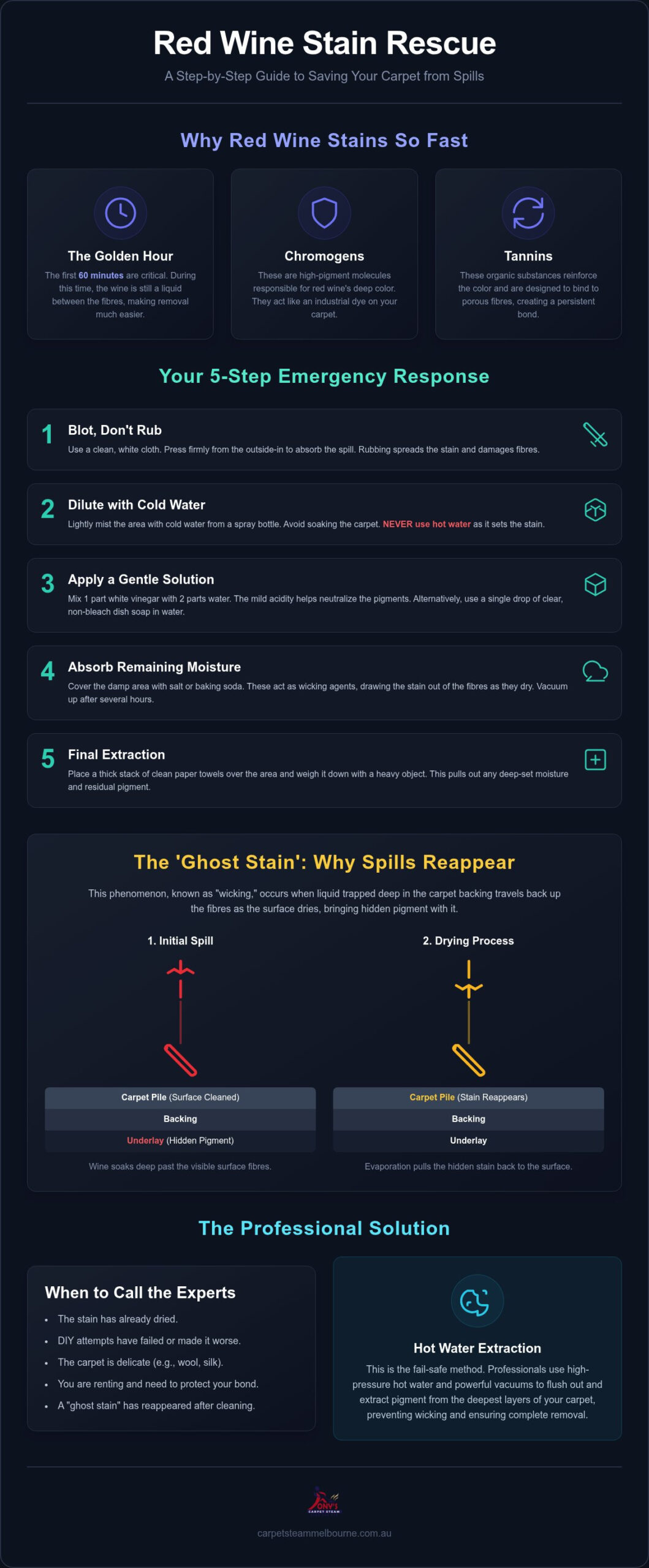
Red wine is more than just a beverage; it’s a complex mixture of organic compounds that behave like industrial dyes. The deep purple hue comes from chromogens, which are high-pigment molecules. These molecules are reinforced by tannins. Tannins are organic dye-like substances that bind to porous fibres. Understanding the chemistry of stain removal helps explain why speed is your greatest ally. When these two elements combine, they create a persistent bond that resists standard vacuuming or light wiping.
The first 60 minutes after a spill is known as the “Golden Hour.” During this window, the wine remains in a liquid state between the carpet fibres. Once that hour passes, evaporation begins, and the pigment starts to bond chemically with the material. In Melbourne’s varying humidity, this process can accelerate. If left too long, the wine essentially dyes the carpet, making red wine stain removal from carpet significantly more difficult for a homeowner to achieve without professional-grade equipment.
The Problem with Porous Fibres
Whether you have wool or synthetic flooring, carpet fibres are naturally porous. When wine hits the surface, gravity pulls the liquid through the pile toward the primary backing and the underlay. This creates a hidden reservoir of pigment. You might successfully clear the surface, but the underlying saturation remains. This is why a carpet can look clean immediately after scrubbing, only for a dark shadow to reappear days later. This phenomenon, known as wicking, occurs as the liquid travels back up the fibres through capillary action during the drying process. Understanding these physical properties is essential for successful red wine stain removal from carpet before the liquid reaches the subfloor.
Why Water Temperature Matters
Temperature plays a decisive role in how a stain behaves. You should never use hot water on a fresh red wine spill. Heat causes thermal expansion, which opens the microscopic scales of natural fibres like wool, which are very common in Melbourne homes. This allows the pigment to penetrate the core of the fibre rather than staying on the surface. Hot water also sets the organic proteins and dyes, effectively baking the stain into the fabric. Always use cold or lukewarm water for dilution. Cold water helps keep the fibre structure tight, preventing the tannins from finding a permanent home in your flooring.
5 Steps for Immediate Red Wine Stain Removal from Carpet
When a glass of red wine hits your carpet, the clock starts ticking. Successful red wine stain removal from carpet depends on your first five minutes of action. Following a systematic approach prevents the pigment from becoming a permanent part of your home’s decor. If you feel overwhelmed during the process, remember that professional carpet steam cleaning is always available to handle the heavy lifting for you and ensure a perfect result.
The Correct Blotting Technique
Friction is your enemy. Never rub or scrub the spill, as this pushes the liquid deeper into the underlay and frays the carpet fibres. Instead, use a clean, plain white cloth to blot the area. Using a coloured towel can cause dye transfer, creating a second problem to solve. Work from the outside of the spill toward the centre. This contained movement ensures the stain doesn’t spread further across the room. Apply firm, downward pressure to pull the liquid up into the cloth. Swap to a fresh section of the towel frequently until no more red pigment appears.
DIY Solutions You Already Have in Your Kitchen
Once you’ve removed the bulk of the liquid, it’s time to dilute. Use a spray bottle filled with cold water to lightly mist the area. Avoid soaking the carpet; excess moisture can lead to mould growth or delamination of the backing. For a more effective treatment, many professional carpet cleaners recommend a simple white vinegar solution. Mix one part white vinegar with two parts water. This acidic balance helps neutralise the tannins and prevents the pigment from bonding to the fibres.
You can also use absorbents like salt or baking soda. These act as wicking agents, pulling moisture out of the pile as they dry. Be cautious with salt on delicate wool fibres, as it can be abrasive. If you use dish soap, ensure it’s a clear liquid and use only a single drop. Coloured or overly sudsy soaps leave a sticky residue that attracts dirt, leading to a dark spot later. Finally, place a weighted stack of paper towels over the area for several hours. This final extraction ensures the deep-set moisture is fully removed, protecting the health of your home environment.
Material Matters: Wool vs. Synthetic Carpets in Melbourne Homes
Not every carpet reacts to a spill in the same way. Melbourne homes often feature high-quality wool blends or durable synthetics, and your approach to red wine stain removal from carpet must account for these material differences. While a synthetic fibre might tolerate a basic kitchen solution, the natural protein structure of wool is far more sensitive. Identifying your flooring type is the first step in ensuring you don’t cause more harm than good.
Wool carpets are particularly common in Melbourne’s established suburbs. They are prized for their durability and natural lanolin coating, which offers a small window of resistance. However, because wool is a protein-based fibre, it reacts to the acidic tannins in red wine similarly to how hair might react to a harsh chemical dye. This makes the removal process a delicate balance of chemistry and caution.
Special Care for Wool-Blend Carpets
Wool requires a specific pH-neutral environment to maintain its integrity. Ideally, cleaning agents should have a pH between 5.5 and 8.0. If you use aggressive alkaline cleaners, you risk “burning” the fibre. This results in permanent yellowing that no amount of professional cleaning can fix. Over-wetting is another common DIY mistake. Excess moisture trapped in wool can create a lingering “wet sheep” odour that is difficult to eliminate. Professional technicians mitigate this by adjusting their equipment to specific temperatures and using high-airflow suction to ensure the wool is sanitised without being saturated.
Synthetic Carpets and Chemical Resilience
Many modern apartments and newer homes in suburbs like Rockbank use synthetic fibres like solution-dyed nylon or polyester. These materials are generally more resilient to DIY spotting. Nylon is often treated with a factory-applied stain shield. While these shields provide a temporary barrier, the acidic nature of red wine can eventually eat through them if the spill isn’t addressed quickly. To identify your carpet, check the original installation receipts or look for a label inside a closet. If the fibres feel plastic-like and have a high sheen, they are likely synthetic.
Use this quick-reference guide to understand how your pile type affects the cleaning process:
- Wool: High absorbency and low chemical tolerance; requires neutral pH and minimal moisture.
- Nylon: Highly durable with good stain resistance; tolerates slightly more aggressive blotting.
- Polyester: Naturally stain-resistant but holds onto oil; handles cold water dilution well.
- Loop Pile (Berber): Traps liquid on the surface longer; easier to blot if you act fast.
- Cut Pile (Plush): Allows liquid to sink deeper into the backing; requires more thorough extraction.
Common DIY Failures and When to Call the Experts
Many homeowners attempt red wine stain removal from carpet using internet “hacks” that often backfire. While these methods are well-intentioned, they can cause irreversible damage to expensive flooring. Successful red wine stain removal from carpet requires specialized equipment that most households simply don’t own. Using the wrong approach doesn’t just leave a mark; it can ruin the carpet’s texture and hygiene for years.
One of the most frustrating failures is the “wicking effect.” You spend an hour cleaning, the carpet looks perfect, and then two days later, the purple shadow returns. Wicking occurs when deep-seated liquid migrates back to the surface during drying. Standard household tools lack the suction power to reach the underlay. This leaves a reservoir of wine in the backing that simply travels back up the fibres as the surface moisture evaporates.
Popular online suggestions like hydrogen peroxide are equally dangerous. While it might lift the red pigment, it frequently strips the original carpet dye. This leaves a permanent white or yellow bleach spot that is far more noticeable than the original spill. Additionally, overusing dish soap leads to “crunchy carpet” syndrome. This sticky residue acts as a magnet for dirt. It turns your old wine stain into a permanent grey smudge that attracts every piece of dust in the room.
The Risks of Over-Saturating Your Floor
Pouring water onto a spill to “flush it out” is a common mistake. Excess water seeps into the backing and underlay where it cannot evaporate. This creates a breeding ground for mould and can cause structural delamination of the carpet. In extreme cases, aggressive DIY flushing leads to the need for flood damage restoration Melbourne services. Home vacuum cleaners are designed for dry soil and cannot extract the volume of liquid required to dry the underlay effectively.
Signs You Need a Professional Intervention
Sometimes, the best move is to stop and call in the experts to save your bond or your investment. You should seek professional help if the stain is larger than a dinner plate, indicating deep saturation. If the wine has been sitting for more than 24 hours, the pigment has likely begun to bond with the fibres. Finally, if you have already used a supermarket spray and the stain remains or has changed colour, stop immediately. Chemical layering makes professional extraction more difficult and increases the risk of permanent fibre damage.
Professional Steam Cleaning: The Ultimate Red Wine Cure
When DIY attempts fail or the spill covers a large area, Hot Water Extraction (HWE) is the gold standard for red wine stain removal from carpet. Unlike surface-level wiping, HWE uses high-pressure water and specialised solutions to reach the base of the pile. This method is the benchmark recommended by the Carpet Institute of Australia for maintaining warranties and extending carpet life. It effectively breaks the chemical bond between the wine tannins and the carpet fibres, ensuring the pigment is removed rather than just hidden.
We use powerful truck-mounted vacuum systems rather than small portable machines. These units provide significantly more suction and consistent heat. This power allows us to extract liquid from deep within the underlay, preventing the wicking effect discussed earlier in this guide. Professional-grade emulsifiers safely break down the complex organic dyes in red wine without stripping your carpet’s original colour. Best Carpet Steam Cleaning Melbourne provides this high-level technology to every residential job, ensuring a fail-safe result when your flooring is at risk.
Our Specialised Stain Treatment Process
Our technicians follow a rigorous protocol to ensure complete restoration. We start with a pre-treatment using pH-balanced spotting agents specifically designed for red wine. These agents neutralise the acidity of the wine immediately. We then use high-temperature steam, carefully calibrated for your specific material, to loosen the dried pigment from the core of the fibre. Finally, our high-pressure extraction systems pull the emulsified stain and all cleaning residues out of the flooring. This leaves your carpet sanitised, fresh, and free from the sticky residues that attract dirt.
Serving the Melbourne Metropolitan Area
Local expertise matters because time is your biggest enemy. We serve the entire metropolitan area, from the CBD to suburbs like Rockbank, providing rapid response times when you have an emergency. Choosing a professional cleaning service Melbourne experts trust ensures you meet strict end-of-lease requirements. Property managers often demand proof of professional steam cleaning to release a bond, especially when red wine spills have occurred. We guarantee a deeper clean than any DIY method, providing the peace of mind that your home environment is restored to the highest hygiene standards.
Protect Your Flooring Investment Today
Mastering red wine stain removal from carpet requires a balance of immediate action and professional precision. You now have the tools to manage the “Golden Hour” and identify whether your wool or synthetic fibres need specialized care. Avoiding common DIY pitfalls like over-saturation and harsh bleaching is essential for maintaining the long-term health and value of your home environment.
When simple blotting isn’t enough, our team provides the ultimate fail-safe for Melbourne residents. We offer a 24/7 emergency response for urgent spills and utilize specialized wool-safe cleaning technology to protect delicate natural fibres. Whether you’re facing a stubborn shadow or need expert end-of-lease stain restoration to secure your bond, we deliver results that standard household tools can’t match.
Don’t let a single spill define the look of your home. With the right steps and professional support, your carpets will look as good as the day they were installed.
Frequently Asked Questions
Can I use white wine to remove a red wine stain?
No, don’t use white wine to treat a red wine spill. While some believe it dilutes the pigment, you’re actually adding more liquid and sugars to the carpet fibres. This can lead to a sticky residue that attracts bacteria and dirt over time. Instead, stick to cold water or a pH-neutral solution for red wine stain removal from carpet. If the stain persists, professional steam cleaning is the most reliable way to clear the pigment safely.
Is it too late to remove a red wine stain if it has already dried?
It is never too late to attempt removal, but dried stains are significantly more difficult to treat. Once the wine dries, the tannins have likely bonded with the carpet pile. You’ll need to rehydrate the area carefully without over-saturating the underlay. For dried spills in Melbourne homes, we recommend skipping DIY hacks and opting for professional hot water extraction. This process uses high-temperature steam to loosen old pigments that have settled deep into the material.
Will salt permanently ruin my carpet if I leave it on too long?
Salt can damage your flooring if it isn’t removed promptly. While it works as an absorbent, salt is naturally abrasive and can fray delicate fibres if walked upon. If left for days, it can also draw moisture from the air, keeping the underlay damp and potentially leading to mould. Always vacuum the salt thoroughly as soon as it has absorbed the liquid. For high-value wool carpets common in Melbourne, baking soda is often a safer, gentler alternative.
Why does the red wine stain keep coming back after I cleaned it?
Stains often reappear due to the “wicking effect.” This occurs when the wine has soaked into the carpet backing or underlay. While the surface looks clean, the liquid remains trapped below. As the carpet dries, the moisture travels back up the fibres, bringing the red pigment with it. Professional red wine stain removal from carpet prevents this by using high-powered truck-mounted vacuums. These systems extract liquid from the very bottom of the pile to ensure the stain is gone for good.
How much does professional red wine stain removal cost in Melbourne?
Professional cleaning rates in Melbourne vary based on the size of the spill and the carpet material. Most local providers, including our team, have a minimum service fee for residential visits. Specialist stain treatments for red wine may incur a small additional charge due to the specific emulsifiers required. We suggest requesting a quote that covers your specific suburb, such as Rockbank, to ensure you receive an accurate price for a deep, restorative steam clean.
Can steam cleaning remove old red wine stains from years ago?
Steam cleaning can often lift old stains, though results depend on whether the fibres were previously damaged by heat or harsh chemicals. If the wine was “set” with a hot iron or a high-alkaline DIY cleaner, the pigment might be permanent. However, professional hot water extraction is highly effective at breaking down aged tannins. Our Melbourne technicians use industrial-grade equipment to reach deep-set pigments that have been trapped in the carpet pile for years.
Does baking soda work better than salt for wine spills?
Baking soda is generally a better choice than salt for most spills. It is less abrasive on natural fibres like wool and works efficiently to neutralise odours while absorbing liquid. Salt can be difficult to vacuum out completely and may leave a gritty residue. Regardless of which absorbent you choose, treat it only as a first-aid measure. You should follow up with a professional steam clean to ensure no organic material remains trapped in the backing.
What is the best professional method for removing wine from wool rugs?
The industry standard for cleaning wool rugs is Hot Water Extraction using pH-balanced solutions. Wool is a sensitive protein fibre that can be “burned” or yellowed by high-alkaline chemicals. Professional cleaners in Melbourne use specialised wool-safe agents and carefully controlled temperatures to sanitise the rug without causing shrinkage. This method ensures the red wine is extracted from the dense pile while preserving the natural lanolin coating that gives wool its durability and soft texture.
