Hot water extraction carpet cleaning: a homeowner’s guide
Hot water extraction carpet cleaning is the right call for most homes, and it’s what almost every carpet manufacturer recommends to keep a warranty valid. Hot water extraction (HWE) injects hot water and a cleaning agent into carpet fibres under pressure, then immediately pulls it back out with a powerful vacuum. Professional machines run water at 65–82°C, follow the IICRC S100 restorative cleaning standard, and pull out over 90% of embedded dust, bacteria and allergens.
Key Takeaways
Hot water extraction works because it rinses and extracts contaminants rather than just applying vapour, which is why it removes over 90% of embedded allergens and stays the manufacturer-preferred method.
| Point | Details |
|---|---|
| HWE is not steam cleaning | It injects hot water at 65–82°C then extracts it with vacuum suction, rather than applying dry vapour. |
| Machine class changes drying time | Truck-mounted units dry in 4–6 hours; portables and rentals often take 12–24 hours. |
| Fibre type sets the rules | Synthetics handle HWE easily; wool needs lower heat and careful pH control. |
| Multiple passes matter | A single extraction pass leaves excess water behind and slows drying significantly. |
| Com delivers warranty-safe results | Trained, insured technicians use properly calibrated equipment for faster drying and consistent results. |
Table of Contents
- What is hot water extraction carpet cleaning?
- What happens during the carpet steam cleaning process, step by step
- Truck-mounted, portable and rental machines compared
- Which carpets and stains suit hot water extraction?
- The benefits and drawbacks of hot water extraction
- Should you rent a machine or call a professional?
- Costs and drying time to expect
- Preparing your home and looking after carpets afterwards
- Warranty rules and safety checks before you book
- The evidence behind hot water extraction
- Sources
- FAQ
What is hot water extraction carpet cleaning?
Most people call it “steam cleaning,” but no steam is actually doing the work. What you see rising off the carpet is water vapour escaping as hot water is injected and immediately extracted by vacuum, not a dry steam sanitising process. The water sits at 65–82°C (150–180°F) in professional gear, hot enough to loosen soil and kill bacteria without cooking the fibres.
The job runs through distinct mechanical stages:
- Pre-vacuum: dry soil and grit removed first, so it doesn’t turn to mud.
- Pre-spray: a cleaning solution applied to break down oils and ground-in dirt.
- Agitation: a brush or machine head works the solution into the pile.
- Injection and extraction: hot water flushes the fibres and is sucked back out in the same pass.
- Neutralise/rinse: a pH-balanced rinse stops sticky residue from attracting new dirt.
- Dry and groom: pile is brushed upright and airflow gets applied to speed drying.
What happens during the carpet steam cleaning process, step by step
Here’s the sequence a competent technician follows on site, and what you should expect to see:
- Inspection: fibre type, stains and problem areas get checked before any water touches the carpet.
- Pre-vacuum: loose debris is removed dry.
- Pre-spray application: a cleaning agent is applied and left to dwell, usually 5 to 10 minutes, so it can break down soil.
- Agitation: a rotary or counter-rotating brush works the solution deeper into the pile, or a carpet rake is used for lighter jobs.
- Hot water injection and extraction: multiple passes flush and pull water from the same section.
- Neutralising rinse: balances pH so no residue is left behind to re-soil quickly.
- Final grooming and drying: pile is set with a groomer and air movers are positioned.
Pro Tip: A single extraction pass rarely gets a carpet properly clean or dry. The second and third passes pull out water the first pass missed, and that’s what actually shortens drying time. If your technician does one quick pass and packs up, that’s a red flag, not efficiency.
Truck-mounted, portable and rental machines compared
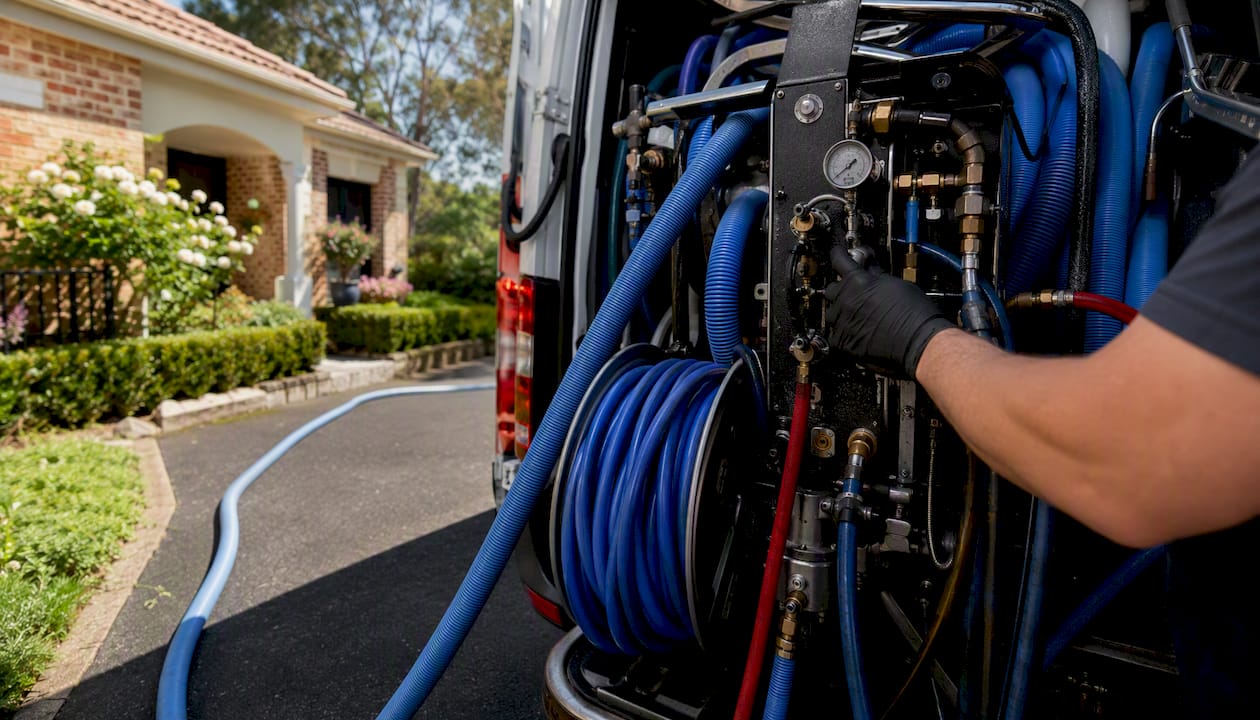
The machine behind the wand matters more than most homeowners realise. A truck-mounted unit draws power straight from the vehicle, so it can sustain higher temperatures, stronger injection pressure and far better vacuum lift than anything plug-in. That’s why truck-mounted jobs typically dry in 4 to 6 hours, while portable and rental machines can leave carpet damp for 12 to 24 hours or longer.
| Machine type | Heat and pressure | Typical drying time | Best suited for |
|---|---|---|---|
| Truck-mounted | High, sustained (65–82°C) | 4–6 hours | Full-home professional cleans |
| Professional portable | Moderate | 12 hours or more | Apartments, no truck access |
| Consumer rental | Low, inconsistent | 12–24+ hours | Small spot jobs, tight budgets |
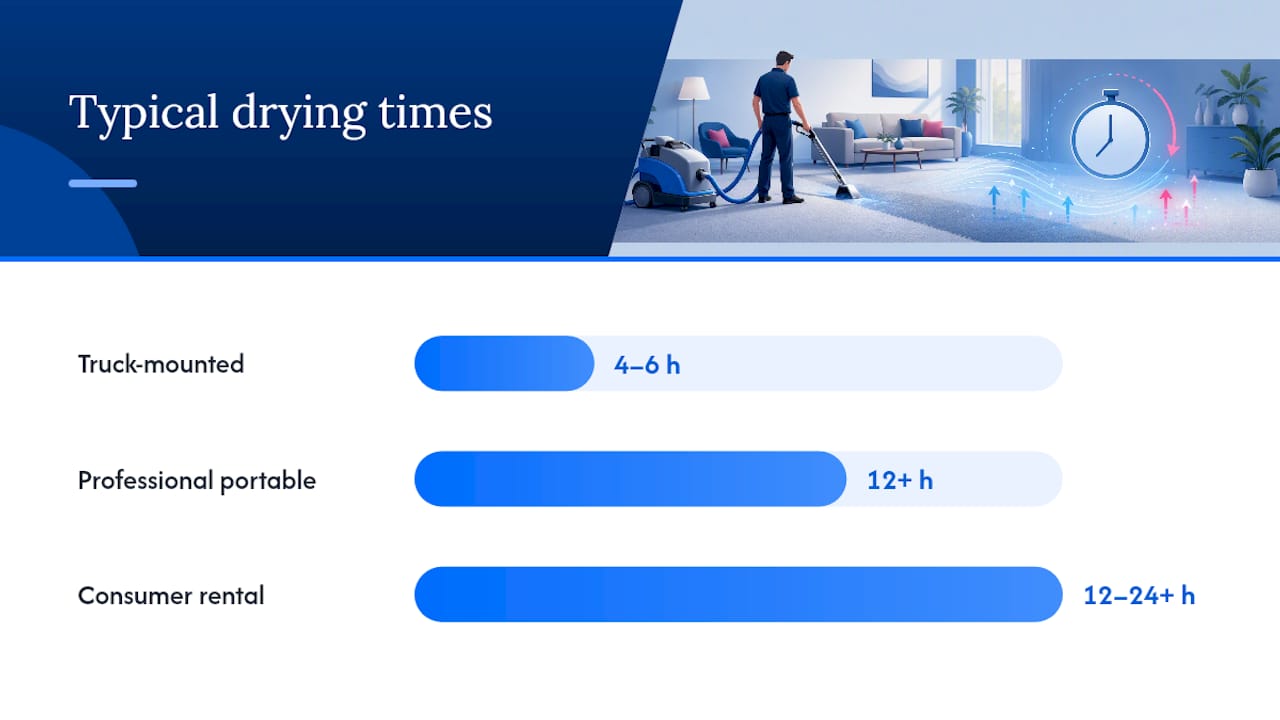
Vacuum recovery is the number that separates these tiers. Injection pressure and airflow specs determine how much water actually comes back out, and weaker rental units simply can’t match the recovery rate of a proper truck-mounted rig.
Which carpets and stains suit hot water extraction?
Synthetic fibres handle HWE without fuss. Nylon, polyester and olefin all tolerate the heat and moisture well, which covers most carpet sold in the last two decades.
- Suits well: nylon, polyester, olefin, most synthetic blends, standard cut-pile and loop-pile constructions.
- Needs caution: wool and silk, where excess heat or aggressive agitation can cause shrinkage or fibre distortion.
- Handles tough stains: pet urine (the rinse action flushes uric acid crystals that cause lingering odour, though old or heavy staining often needs pre-treatment), ground-in dirt, and general traffic soiling.
- Trickier territory: oil-based stains and dye transfer, which may need a specialised pre-treatment before extraction rather than relying on the rinse alone.
| Fibre type | HWE suitability | Notes |
|---|---|---|
| Nylon | Excellent | Standard temperature range, no special handling |
| Polyester | Excellent | Tolerates heat well, resists water damage |
| Olefin | Good | Low moisture absorption, dries quickly |
| Wool | Conditional | Lower temperature and pH-neutral solution required |
The benefits and drawbacks of hot water extraction
The upside is substantial, but it’s not a free lunch.
- Removes deep allergens: HWE lifts over 90% of embedded dust mites, bacteria and allergens from carpet fibres and padding.
- Lifts stubborn stains: the combination of heat, agitation and rinse action outperforms dry or low-moisture methods on ground-in soil.
- No sticky residue: proper neutralising rinse means carpets don’t re-soil faster afterward.
- Manufacturer-recommended: most major carpet brands list HWE as the preferred warranty maintenance method.
- Drawback: drying time: carpets stay damp for hours, sometimes longer with weaker machines.
- Drawback: over-wetting risk: underpowered rental units can push in more water than they recover.
Pro Tip: Professionals reduce over-wetting by matching water volume to the machine’s actual recovery rate, then finishing with air movers positioned to cross-ventilate the room. That combination is what keeps a truck-mounted job to a same-day dry.
Should you rent a machine or call a professional?
Run through these before deciding:
- Check your carpet fibre: wool or specialty fibres favour a professional who can control temperature and pH precisely.
- Check your warranty terms: many manufacturers require professional cleaning receipts to keep coverage valid.
- Assess the soil load: heavy traffic lanes, old pet stains or post-renovation dust usually need professional-grade extraction pressure.
- Consider access: apartments and upper floors may rule out truck-mounted equipment entirely, which changes your options.
- Weigh drying sensitivity: allergy sufferers or homes with young kids benefit from the faster drying a truck-mounted service delivers.
If you’re renting, demand real numbers before you sign anything: injection pressure, tank capacity and vacuum airflow (CFM). A rental unit with weak vacuum lift will leave your carpet wetter for longer, and that’s when problems like mould or fibre distortion creep in. If your carpet is under warranty, heavily soiled, or you’ve had a pet accident that’s soaked into the padding, booking a professional is the safer bet.
Costs and drying time to expect
DIY rental runs cheapest upfront but costs more in time and risk. A professional call-out costs more per visit but usually includes stronger equipment, faster drying and a satisfaction guarantee.
- Drying time factors: humidity, airflow, carpet pile depth and machine recovery rate all shift the window.
- Truck-mounted jobs: typically 4 to 6 hours to dry.
- Portable or rental jobs: often 12 hours or more, sometimes stretching past a day in humid conditions.
- Speed it up: air movers, a dehumidifier, and open windows or running the AC all cut drying time noticeably.
Most homes only need this every 6 to 12 months, though pet owners and high-traffic households should aim for every 3 to 6 months.
Preparing your home and looking after carpets afterwards
A little prep saves a lot of drying time and protects your fibres.
- Clear small furniture and breakables from the room beforehand.
- Vacuum thoroughly so the technician isn’t extracting dry grit along with the wet soil.
- Test an inconspicuous patch for dye stability if you’re doing this yourself.
- Have warranty paperwork on hand if you need it for a claim later.
For the first 24 hours, make sure to follow timing and drying advice as explained in carpet cleaning’s role in the move-out process to protect your carpet’s condition.
- Keep foot traffic to a minimum, especially bare feet and pets.
- Run fans or air conditioning to keep air moving through the room.
- Avoid walking in shoes that could grind residual moisture into the pile.
- Skip any shampoo or spot-treatment product until the carpet is fully dry.
Warranty rules and safety checks before you book
Most manufacturers specify HWE, sometimes at a defined interval, as a condition of maintaining your warranty, so check your paperwork before assuming any cleaning method will do.
- Confirm the water temperature limit for your fibre type, wool needs cooler water and gentler handling than synthetics.
- Ask whether the cleaning solution is pH-neutralised at the rinse stage, since leftover alkaline residue attracts dirt fast.
- Keep your service receipt. It’s the only proof you’ll have if you ever need to make a warranty claim.
The evidence behind hot water extraction
Industry data backs this method up consistently. Hot water extraction removes over 90% of embedded contaminants including dust mites, bacteria and trapped allergens, a figure that’s driven most major carpet manufacturers to specify it as their required maintenance method. The IICRC S100 standard formalises the protocol: pre-inspection, pre-vacuuming, pre-conditioning, agitation, extraction and controlled drying, in that order, as the benchmark for restorative carpet cleaning.
The gap between machine classes shows up directly in outcomes. Truck-mounted systems sustain higher temperatures and stronger vacuum recovery than portables, which is why they consistently produce faster drying and deeper soil removal in side-by-side comparisons.
A cleaner’s view on what homeowners get wrong
The most common mistake we see is rushing the extraction passes, one quick run with the wand instead of two or three. That leaves water sitting in the padding, and that’s when odour and mould problems start. Trained, insured technicians using properly calibrated equipment avoid that entirely.
If you want a guaranteed, warranty-safe clean
Renting a machine seems cheaper until you’re three hours into a job with a rental unit that can’t pull enough water back out. Com runs professional-grade equipment that hits the right temperature and vacuum recovery every time, so you get a warranty-safe result without babysitting a rental machine on a Saturday.

Book a clean and you can expect:
- Trained, insured technicians running truck-mounted or professional portable equipment matched to your carpet type.
- Drying times in the 4 to 6 hour range under normal conditions, not the next-day wait common with rental gear.
- A satisfaction guarantee backing every job.
- Correct pH-neutralising rinse, so your carpet doesn’t re-soil faster afterward.
If you’re in Melton, book your carpet steam clean directly, or check preparation steps so you know exactly what to do before the technician arrives.
Sources
- Benefits of Hot Water Extraction Explained (2026 Guide) – Jonis Cleaning
- Hot water extraction — Wikipedia
- What Is Carpet Extraction? | Hot Water Extraction Explained | US Cleaning Tools
FAQ
Is hot water extraction the same as steam cleaning?
Not technically. HWE injects hot water and rinses it back out with vacuum suction; true steam cleaning applies vapour and generally doesn’t rinse, which is why HWE lifts more embedded soil.
How long does carpet take to dry after hot water extraction?
Truck-mounted jobs typically dry in 4 to 6 hours. Portable or rental machines can take 12 to 24 hours, depending on humidity, airflow and pile depth.
Will hot water extraction damage wool carpet?
Not if it’s done correctly. Wool needs lower water temperatures and a pH-neutral solution, which is why professional handling matters more for natural fibres than synthetics.
Does renting a machine void my carpet warranty?
Check your paperwork first. Many manufacturers specify professional cleaning at set intervals to keep the warranty valid, so a DIY rental clean may not satisfy those terms.
How often should carpets get hot water extraction?
Every 6 to 12 months for typical households, and every 3 to 6 months if you’ve got pets or heavy foot traffic.
