Homeowners: 5 Quick Checks to Confirm a Cleaner’s Insurance
Yes. A professional cleaner should carry public liability insurance, and you should confirm it with a Certificate of Currency before the first booking. Insurance covers third-party injury and accidental property damage, the two things most likely to go wrong in your home or office. If a cleaner can’t produce that certificate on request, treat it as a reason to keep looking.
TL;DR:
- A Certificate of Currency is essential to verify that a cleaner’s insurance is active, with proper coverage for third-party injury and property damage.
- Public liability coverage typically starts at $5 million but many jobs, especially commercial or high-value projects, require limits up to $10 million.
- Workers’ compensation and bonding are key additional policies; the former protects staff on site, while the latter covers theft by staff.
- Insured cleaners generally demonstrate better business practices, such as background checks, training, and consistent service quality.
- Always document and confirm policy details directly with the insurer before hiring, especially for larger, high-risk, or commercial cleaning jobs.
Table of Contents
- Why insurance matters when you book a cleaning service
- What types of cover should a cleaner actually carry?
- How do you actually verify a cleaner’s insurance?
- When should you insist on higher limits or a bond?
- What to do if something goes wrong during a clean
- Why we recommend booking insured, professional teams
- Ready to book an insured cleaning team in Melbourne?
- Sources
Why insurance matters when you book a cleaning service
Cleaning is physical work done in someone else’s space, often with water, chemicals and heavy equipment near expensive surfaces. Things break. People slip. A steam cleaner catches a skirting board, a client trips over a cord, a bottle of stain remover marks a marble bench. None of that is rare.
Public liability insurance for cleaners covers third-party personal injury and accidental property damage that happens during the job. It does not usually cover:
- Disputes over the quality of the clean itself
- Theft, unless the cleaner is separately bonded
- Damage to items in the cleaner’s care or custody without specific extra cover
Insured operators tend to look different from the outside too. Companies that carry proper cover typically also run background checks, formal training and rostered backup staff, because insurers and clients both expect it. BizCover’s guidance for cleaning businesses notes that insured, bonded operators generally show stronger operational habits: fewer missed appointments, better callback rates, more consistent service. Insurance and reliability tend to travel together, not because one causes the other, but because both come from the same disciplined business.
What types of cover should a cleaner actually carry?
Three separate products do three separate jobs. None of them substitutes for the others, and a cleaner missing one of them leaves a gap in your protection.
- Public liability (commercial general liability). This is the core policy. It pays out for third-party injury and accidental property damage caused during the clean. Limits commonly sit at $5 million or $10 million, with premiums for cleaners starting from roughly $24 a month, and most paying between $38 and $70 a month depending on the limit and business size.
- Workers’ compensation. This protects the cleaner’s own staff if they’re injured on your property, and it protects you too, because a worker hurt on site with no cover behind them can leave the property owner exposed to a claim. Any cleaner with employees should carry this as standard.
- Bonding (a janitorial bond). A bond is distinct from liability cover. It’s specifically there to protect you from theft by staff, something standard public liability policies typically exclude. Bonds carry their own separate limits, so ask what the maximum recoverable amount actually is.
Public liability can also exclude items in the cleaner’s “care, custody and control” unless that’s added as a specific extension, according to Public Liability Australia. That gap matters more than most clients realise, particularly for anyone handling rugs, artwork or equipment off site for cleaning.
How do you actually verify a cleaner’s insurance?
Asking “are you insured?” and accepting a yes is not verification. A Certificate of Currency is the only document that confirms a policy is genuinely active, and it takes most cleaners a few minutes to send.
When one lands in your inbox, check it against this list:
- Insurer name and policy number match a real, recognisable insurer
- Effective dates cover your actual booking date, not just “this year”
- Listed cover types include public liability, and workers’ compensation if the cleaner has staff
- Per-occurrence limit is stated, not just an annual aggregate
- Your property is named, or can be named, as an additional insured
Naming the property as additional insured matters more than most clients expect. It means you can claim directly against the policy if something goes wrong, even if the cleaning business folds or goes quiet afterwards. For commercial or high-value bookings, also ask about equipment cover, keyholding cover and whether care, custody and control is included.
Pro Tip: If any detail on the certificate looks vague or dated, call the insurer directly using the number on the certificate, not one the cleaner gives you. A five-minute call confirms the policy is real and current.
Save a copy of every certificate you receive. It costs nothing and it’s the first thing an insurer or lawyer will ask for if a claim ever needs to be made.
When should you insist on higher limits or a bond?
Not every booking carries the same risk, and the cover that’s fine for a weekly home clean is often too thin for a bigger job.
- Strata and common areas. Damage in a shared lobby or lift affects every resident, not just one unit, so body corporates typically require higher limits before approving a contractor.
- Property manager bookings. Managers acting for an owner usually have contractual minimums written into their agreements, often well above what a private homeowner would think to ask for.
- High-value finishes. Marble, natural stone, antique furniture and specialist flooring raise the cost of a mistake, which is exactly when care, custody and control cover becomes worth confirming.
- Keyholding arrangements. Handing over a key changes the risk profile entirely and often triggers a request for a specific keyholding clause.
As a rough benchmark, $5 million is common for standard residential and small commercial work, while $10 million tends to appear on property management contracts, strata jobs and larger commercial sites. Coverage limits are generally set by the client’s contract or platform requirements rather than by the cleaner, so domestic clients often accept lower limits while commercial contracts push for more. If you manage several properties, it’s worth deciding your minimum limit in advance rather than negotiating it job by job. Documented trust signals like this are part of why testimonials and verification carry real weight when choosing any contractor, cleaning included.
What to do if something goes wrong during a clean
Most incidents are minor. A few aren’t, and how you respond in the first hour shapes how smoothly any claim goes afterwards.
- Deal with safety first. Secure the area, switch off any water or power source involved, and look after anyone injured before anything else.
- Document everything. Photograph the damage or injury immediately, note the time, and get contact details from any witness on site.
- Notify the cleaner straight away and ask for their insurer’s contact details and a claim reference number.
- Put it in writing. Follow up the conversation with an email or message summarising what happened, so there’s a dated record.
- Loop in the property manager or landlord if the property isn’t yours, and keep copies of every message that follows.
- Don’t admit fault or agree to a settlement figure on the spot. Let the insurer investigate before anyone commits to anything.
Pro Tip: Photograph the room before the cleaner starts, not just after something breaks. A “before” photo removes any doubt about what changed during the visit.
Why we recommend booking insured, professional teams
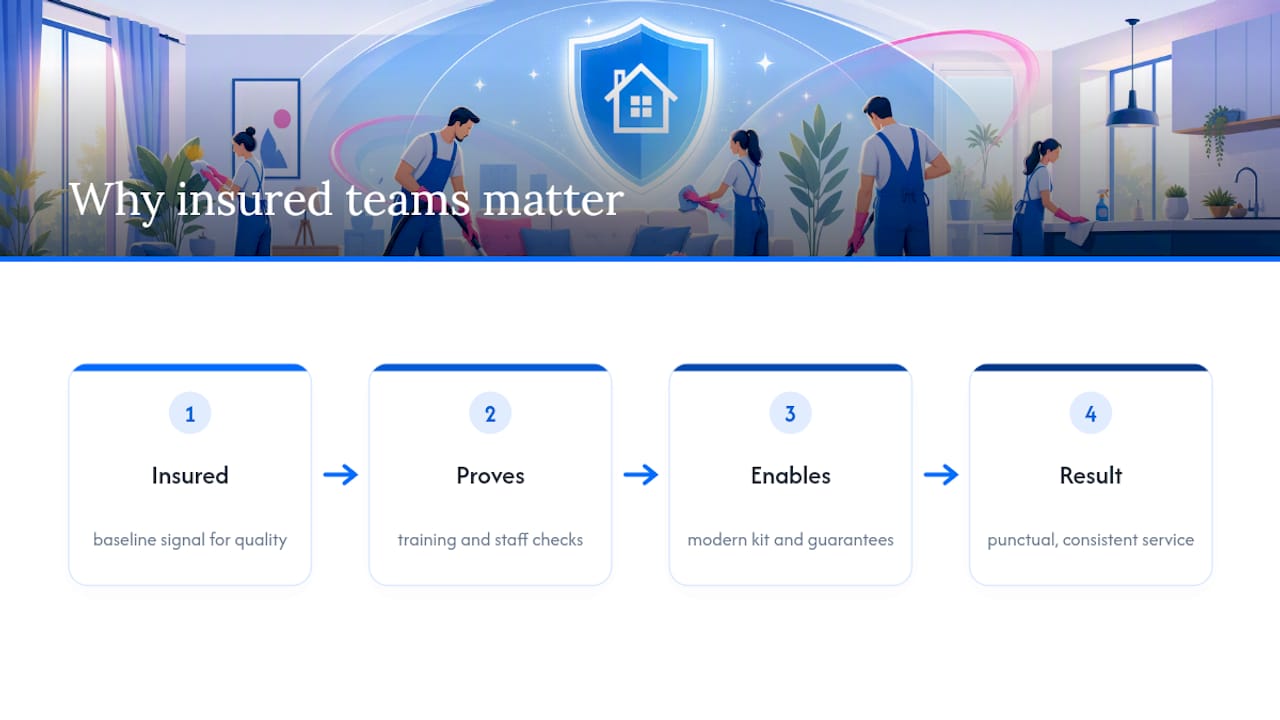
Insurance is the baseline, not the whole story. What it really signals is a business that has invested in training, staff checks and systems solid enough for an insurer to back. Com supplies insured, trained staff and will provide a Certificate of Currency to any client who asks before a booking is confirmed.
That same discipline shows up elsewhere: modern equipment, same-day service where it’s needed, and satisfaction guarantees that only make sense if the underlying work is consistent. A cleaner willing to hand over policy documents without hesitation is usually the same cleaner who shows up on time and does the job properly. That correlation isn’t a coincidence, and it’s worth treating as a genuine filter when you’re choosing who gets a key to your property.
— Roney
Ready to book an insured cleaning team in Melbourne?
There are cleaning services that provide insured, trained staff and will email a Certificate of Currency before your booking is confirmed, so you’re checking the box before anyone sets foot on site, not after.
Our teams cover carpet steam cleaning, tile and grout cleaning, end-of-lease cleans, and flood damage restoration, using eco-friendly, chemical-free methods across residential and commercial properties. Higher-risk sites are covered too. Our aged care carpet steam cleaning service is built around the stricter documentation and hygiene standards those properties require. To book, get in touch through our site and ask for a Certificate of Currency along with your quote. We’ll send both before you confirm the date.
Sources
- Do I need public liability insurance as a cleaner? — Upcover
- Certificates of currency — Surewise
- Insurance for cleaners — BizCover
- What does public liability insurance cover in a cleaning business? — Public Liability Australia
