Vomit carpet cleaning: quick, practical steps for homeowners
Remove the solids first. That single action, done in the first two minutes, determines whether you end up with a manageable surface stain or a contamination problem that reaches the carpet backing. Once the solids are gone, blot — never rub — working from the outer edge toward the centre. Then apply an absorbent or enzyme product immediately. That sequence is the whole game.
Here is the immediate checklist:
- Put on disposable gloves before you touch anything. If illness is involved, add a mask.
- Scoop solids with a dull spoon, spatula, or stiff card. Work inward from the edges so you do not spread the stain.
- Blot liquid with white absorbent cloths or paper towels. Press firmly, lift, move to a clean section. Never wipe sideways.
- Apply a generous layer of baking soda or cornstarch over the damp area. Leave it for 15–30 minutes to absorb residual moisture and odour.
- Vacuum up the powder, then apply an enzyme cleaner according to the label. Most products need extended contact time for protein-based soils.
- Ventilate the room immediately: open windows and run a fan. Airflow speeds drying and reduces bacterial growth.
Pro Tip: Press your palm firmly onto the cleaned area after blotting. If it feels cold and damp well below the surface pile, liquid has likely reached the backing or underlay. That is the point at which surface cleaning alone will not remove the odour permanently.
Use cold or lukewarm water throughout. Heat applied early bonds proteins and fats from vomit into carpet fibres, making the stain significantly harder to shift.
Table of Contents
- What supplies do you need before you start?
- How to clean vomit from carpet: step-by-step
- How do you treat dried or set-in vomit stains?
- Why does vomit odour come back, and how do you remove it for good?
- Does carpet fibre type change how you clean vomit?
- Common mistakes that make vomit stains and odours worse
- When should you call a professional carpet cleaner?
- Simple measures that reduce the risk next time
- Safe at-home remedies and what to avoid
- Why do professionals get better results than DIY?
- Key takeaways
- The part most guides skip
- Professional carpet cleaning in Melbourne for stubborn vomit stains
- Useful sources and further reading
What supplies do you need before you start?
Having the right kit assembled before you begin prevents the two most common errors: over-wetting from improvised containers and using the wrong chemistry on the wrong fibre.
Essential cleaning supplies:
- White absorbent cloths or plain white paper towels (coloured cloths can transfer dye)
- Dull spoon, plastic scraper, or stiff card for solid removal
- Baking soda or cornstarch
- Enzyme cleaner formulated for protein-based biological soils
- Spray bottle filled with cold water (never pour directly from a jug)
- Soft-bristled brush for gentle agitation on synthetic fibres only
- Vacuum cleaner with good suction
- Portable fan or access to open windows
Safety and hygiene items:
- Disposable nitrile or latex gloves
- Disposable face mask if the incident is illness-related
- Sealed disposal bag for used cloths and solids
On product selection: enzyme cleaners are the right choice for vomit because vomit contains proteins, acids, fats, and food colourings that standard detergents cannot fully break down. Baking soda handles short-term absorption and odour control, but it does not digest the biological material the way enzymes do. Avoid bleach on any coloured carpet — it will strip dye from the fibres before it does anything useful to the stain.
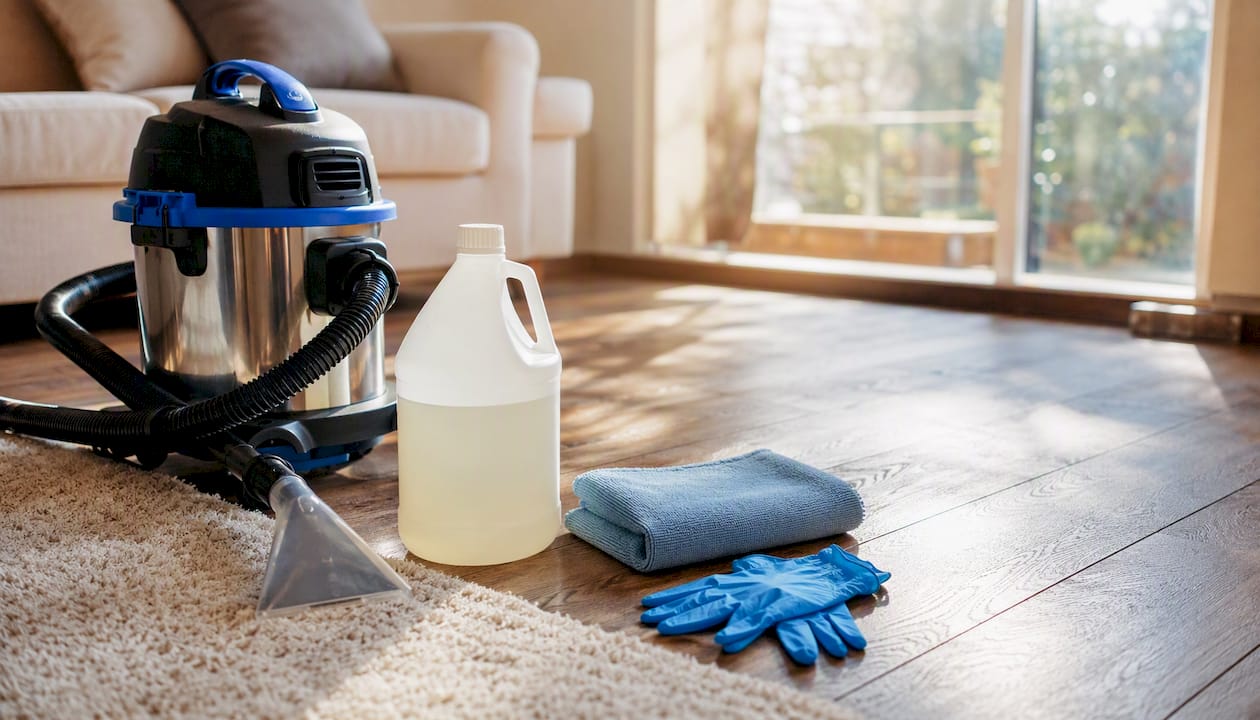
For extraction equipment, a household wet/dry vacuum removes surface moisture adequately for small, fresh incidents. A rented carpet extractor gives you more suction depth and is worth considering for larger areas or if the liquid has visibly soaked through. Professional truckmount extraction goes deeper still and is the only reliable option when contamination has reached the pad. The difference between rental and professional extraction comes down to water pressure, suction power, and drying speed.
How to clean vomit from carpet: step-by-step
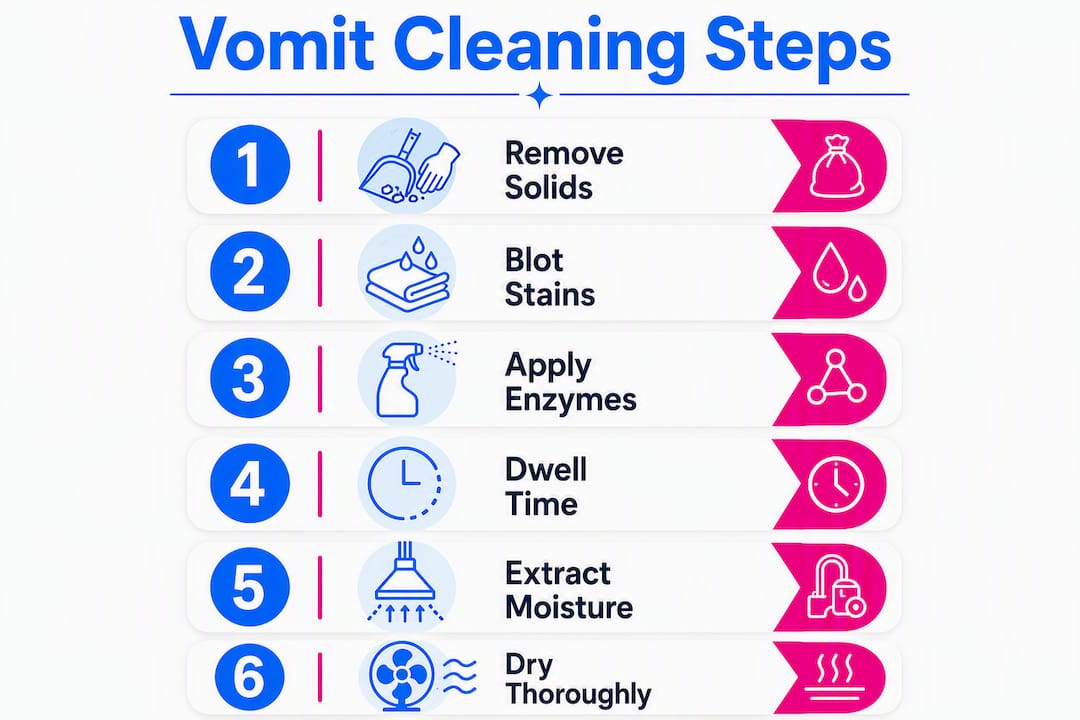
Vomit is classified as a moderate-difficulty stain; the longer it sits, the higher the risk of permanent discolouration because acidic enzymes and proteins bond with fibres, especially when heat or drying accelerates the process. Work through these steps in order.
- Prepare the area. Put on gloves. Open windows and run a fan. Place a disposal bag nearby.
- Remove solids. Use a dull spoon or scraper to lift solids from the outside edge inward. Deposit directly into the disposal bag. Do not press down.
- Blot liquid. Press a folded white cloth firmly onto the stain. Lift straight up. Move to a clean section of cloth. Repeat, always working outside-in. Never rub or wipe sideways.
- Apply absorbent. Cover the damp area generously with baking soda or cornstarch. Leave for 15–30 minutes. Vacuum thoroughly.
- Apply enzyme cleaner. Spray lightly — a fine mist, not a pour. The area should be damp, not wet. Follow the product’s dwell time; most enzyme cleaners for biological soils need several hours of contact time for persistent odour. Cover with a damp cloth to prevent the product drying out before it finishes working.
- Blot again. After the dwell time, blot up the enzyme product with clean cloths. Do not rinse aggressively — a light mist of cold water followed by firm blotting is enough.
- Dry aggressively. Run a fan directly over the area. If possible, open windows on opposite sides of the room to create cross-ventilation. Damp carpets that dry slowly allow bacterial growth that produces odour even after visible soils are gone.
- Check and repeat if needed. Once dry, smell the area and press your palm into the pile. If odour or dampness remains, repeat from step 5.
| Step | Action | Dwell time |
|---|---|---|
| Solid removal | Scoop outside-in with dull scraper | Immediate |
| Blotting | Press and lift with white cloth | Until no transfer |
| Absorbent application | Baking soda or cornstarch | 15–30 minutes |
| Enzyme cleaner | Fine mist, cover with damp cloth | Several hours (per label) |
| Final blot and dry | Blot residue, run fan | Until fully dry |
Do not use hot water at any stage until the stain is fully treated. Do not scrub the pile. Do not flood the area with liquid from any source.
Pro Tip: After applying the enzyme cleaner, lay a damp towel over the treated area and place a heavy book on top. This keeps the enzyme in contact with the fibres longer without adding excess moisture, which is exactly what the chemistry needs to work.
How do you treat dried or set-in vomit stains?
Dried vomit presents a different problem. The proteins and acids have already begun bonding with the fibres, and the residue is often brittle on the surface while still tacky or odorous deeper in the pile. The answer is controlled rehydration, not aggressive scraping or soaking.
Controlled rehydration — light misting, short wait, blot cycles — is the recommended approach; aggressive scraping or heavy soaking pushes residue into the backing and makes the problem significantly harder to fix.
How to rehydrate and treat a dried stain:
- Mist the dried residue lightly with cold water. Wait two minutes. The residue should soften slightly.
- Gently lift softened material with a dull scraper. Do not press hard.
- Blot the area with a clean cloth. Repeat the mist-wait-blot cycle two or three times rather than applying a large volume of water at once.
- Once the bulk of the residue is lifted, apply an enzyme cleaner. For set-in stains, lay a damp cloth over the treated area to extend contact time. Leave for several hours.
- Blot, then dry with high airflow.
For guidance on removing set-in carpet stains at home, the same controlled approach applies across most biological soils.
Warnings: Do not use a steam cleaner or hot water on a dried vomit stain. Heat at this stage cooks the remaining proteins into the fibres. Do not scrub with a stiff brush — mechanical agitation drives residue deeper into the pile and can fray the surface.
If repeated surface cycles fail to remove the odour, or if the backing feels damp or smells after the carpet has dried fully, the contamination has moved below the face fibres. Surface cleaning will not resolve it.
Why does vomit odour come back, and how do you remove it for good?
The odour returns because the source has not been removed. Vomit contains acids, enzymes, fats, and food colourings; even when a spot looks clean, microscopic residues remain in the pile and backing, producing odour as they continue to break down. Masking sprays cover the smell temporarily, but once the masking agent dissipates, the biological material underneath keeps producing it.
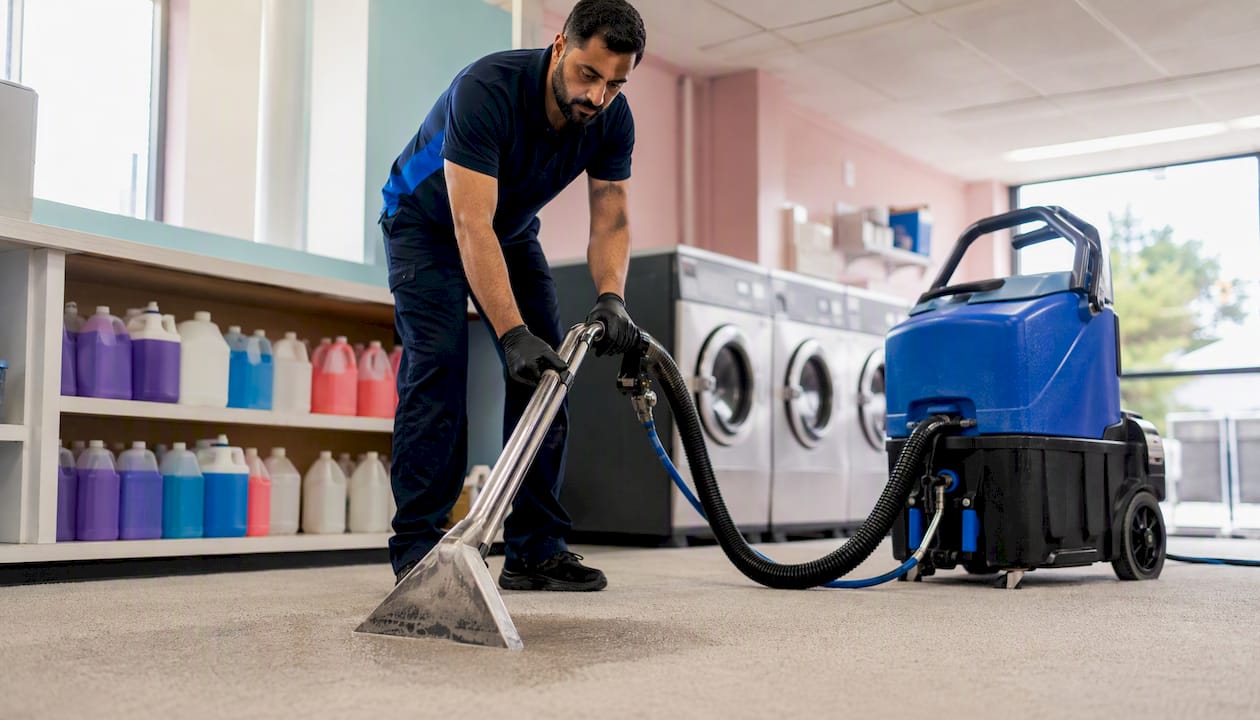
Permanent odour removal requires one of two things: enzyme chemistry that digests the biological residue, or physical extraction that removes it. Often both.
Practical odour-control steps:
- Apply an enzyme cleaner with adequate dwell time. Enzyme contact time can be several hours for persistent smells — do not rush this step.
- Keep the treated area damp (not wet) during the dwell period so the enzymes stay active.
- After treatment, dry aggressively with a fan and open windows. Bacteria thrive in damp, warm conditions and will generate new odour even after the original soils are treated.
- For persistent carpet odours, a second enzyme application the following day is often more effective than a single long soak.
Verification steps once the carpet is fully dry:
- Smell the area at nose level, not standing height. Odour concentrates near the floor.
- Press your palm into the pile for ten seconds. Residual warmth or a faint smell on your hand indicates remaining contamination.
- Check the underside of the carpet at the edge of the affected area if accessible. Discolouration or odour on the backing confirms deeper contamination.
If odour persists after two full enzyme treatment cycles and thorough drying, the contamination has reached the pad. At that point, professional extraction is the only reliable fix.
Does carpet fibre type change how you clean vomit?
Yes, significantly. Wool and natural-fibre carpets react very differently to cleaning chemistry and moisture compared to synthetic fibres like nylon or polyester. Getting this wrong can cause shrinkage, felting, or permanent colour change.
Wool and natural fibres:
- Wool is sensitive to pH. Strong alkaline products (including some enzyme cleaners not formulated for wool) can cause irreversible fibre damage. Check that any enzyme cleaner you use is pH-neutral or wool-safe. WoolSafe maintains a directory of approved products for wool carpets.
- Use minimal moisture. Wool absorbs water readily and dries slowly, which increases the risk of shrinkage and mould if over-wetted.
- Never use hydrogen peroxide or strong alkaline degreasers on wool.
- Blot more, spray less. A fine mist is the maximum moisture you should apply.
- Drying time for dense wool pile is longer than for synthetics. Run a fan for at least 6–8 hours and check that the backing is dry before replacing furniture.
Synthetic fibres (nylon, polyester, polypropylene):
- More tolerant of enzyme cleaners and mild detergent solutions.
- Dry faster, but still benefit from active airflow rather than passive drying.
- A soft-bristled brush can be used gently after enzyme treatment to help lift the pile, but avoid stiff brushes.
If you are unsure of your carpet’s fibre composition, treat it as wool. The conservative approach costs nothing; the aggressive one can cost you the carpet. For any wool, silk, or antique rug, a fibre-specific specialist is worth calling before you attempt DIY treatment.
Common mistakes that make vomit stains and odours worse
Most DIY failures come down to a handful of repeatable errors. Each one either sets the stain permanently or drives contamination deeper.
- Rubbing instead of blotting. Rubbing spreads the stain laterally and pushes residue further into the pile. Every wipe sideways makes the affected area larger.
- Over-wetting. Aggressive scrubbing and over-wetting are the most common DIY mistakes that turn a surface stain into a deep-set contamination problem. Sprays should be a fine mist. Never pour liquid directly onto carpet.
- Using hot water or steam too early. Heat cooks proteins and fats into the fibres, increasing the chance of a permanent stain. Cold or lukewarm water only until the stain is fully treated.
- Applying bleach to coloured carpet. Bleach strips dye from carpet fibres. The stain may lighten, but so will the surrounding carpet, leaving a permanent pale patch.
- Using undiluted detergent. Concentrated detergent leaves a sticky residue that attracts dirt and is difficult to rinse out fully without over-wetting.
- Aggressive scrubbing with a stiff brush. This frays the pile surface and can permanently alter the carpet’s texture.
- Relying on masking sprays. Perfumed sprays do not remove biological residues. The smell returns once the fragrance dissipates.
A note on illness-related incidents: if the vomit is from a person who is unwell with a contagious illness, standard cleaning is not sufficient. The area needs a disinfection step after the stain is treated. Use a product rated for biological disinfection, follow the contact time on the label, and consider professional treatment for peace of mind. For related guidance on biohazard and excrement stain removal, the same safety principles apply.
When should you call a professional carpet cleaner?
Some incidents are beyond what surface cleaning can fix. Knowing when to stop and call a pro saves you from repeating ineffective cycles and potentially making the damage permanent.
Signs that DIY is not enough:
- Odour returns after the carpet has dried fully, even after two enzyme treatment cycles.
- The backing or pad feels damp or smells when checked from the edge.
- The incident involved repeated vomiting or a large saturated area.
- The carpet is wool, silk, or a delicate natural fibre.
- Earlier DIY attempts involved over-wetting or scrubbing.
- The incident is illness-related and disinfection is required.
What professionals do differently:
Professionals use controlled extraction equipment that removes contamination from the backing and pad, not just the face fibres. Surface-level cleaning often leaves odour because contamination has moved into the backing or pad; persistent odour after drying is a clear sign that professional extraction or pad replacement may be needed. Hospital-grade enzyme treatments are applied at higher concentrations with controlled dwell times. Drying is managed with commercial-grade air movers, not household fans.
For a detailed look at professional versus DIY carpet cleaning outcomes, the gap in results is most visible in biological soil incidents precisely because depth of extraction matters so much.
Typical costs in Australia: professional carpet cleaning for a single room in Melbourne generally ranges from around $80–$150 depending on room size, fibre type, and severity of contamination. Pad replacement, if required, adds to that cost. Same-day or emergency response services may carry a premium.
Questions to ask before booking:
- Are your staff trained and insured?
- Do you use enzyme treatments, and what contact time do you allow?
- What extraction equipment do you use — portable or truckmount?
- Is pad inspection included, and what happens if the pad needs replacing?
- Do you offer a satisfaction guarantee?
Simple measures that reduce the risk next time
A few household habits make future incidents much easier to manage and reduce the chance of contamination reaching the pad.
- Place washable rugs over carpet in high-risk areas: near beds, in children’s rooms, and in front of sofas. A washable rug takes the hit instead of the carpet underneath.
- Keep easy-to-wash throws near beds, particularly for children or anyone prone to illness.
- Position a small bin with a liner near the bed during illness. It sounds obvious, but it prevents the worst-case scenario.
- Assemble a small emergency kit and store it somewhere accessible: enzyme spray, white cloths, disposable gloves, a dull scraper, and baking soda. Having it ready means you act in the first two minutes rather than spending them searching cupboards.
- Vacuum high-traffic areas at least weekly. Regular vacuuming removes dry organic matter that would otherwise contribute to odour retention if a liquid incident occurs.
- Schedule professional extraction once or twice a year. Regular deep cleaning removes the background accumulation of biological soils that makes any new incident harder to treat.
Pro Tip: Place a folded washable rug or absorbent mat under the bed and beside the sofa. If an incident happens at night, the mat absorbs the bulk of the liquid before it reaches the carpet pile. That single layer of protection can be the difference between a quick machine wash and a professional extraction job.
Safe at-home remedies and what to avoid
A few reliable DIY mixes work well as part of the cleaning process. None of them replace enzyme cleaners for permanent odour removal, but they are useful at the right stage.
Reliable home remedy recipes:
- Baking soda absorption: Apply dry baking soda directly to the damp area after blotting. Leave for 15–30 minutes, then vacuum. This draws out residual moisture and provides short-term odour control. It does not digest biological residue.
- Dish soap and white vinegar rinse: Mix one teaspoon of clear dish soap with one tablespoon of white vinegar and 250ml of cold water. Apply with a spray bottle — a fine mist only. Blot with a clean cloth. This solution works as a rinse step to lift surface residue after the bulk of the stain is removed. Use cold water only.
- Plain cold water rinse: After enzyme treatment, a light mist of cold water followed by firm blotting removes product residue without over-wetting.
What not to use:
- Hot water at any stage of initial treatment
- Undiluted bleach on coloured carpet
- Perfumed masking sprays as a primary treatment
- Ammonia-based cleaners (the smell can attract pets back to the same spot)
- Carpet shampoo applied by pouring rather than spraying
Home remedies like baking soda and vinegar are useful support steps but do not break down protein-based soils the way enzyme products do. Use them to manage the immediate mess, then follow with an enzyme cleaner for permanent odour removal.
When using vinegar, ventilate the room. The acetic acid smell dissipates quickly but is strong in an enclosed space. Never mix vinegar with bleach — the combination produces chlorine gas.
Why do professionals get better results than DIY?
The gap comes down to depth of extraction, enzyme concentration, and drying control. Surface cleaning — blotting, applying a product, blotting again — removes what is in the face fibres. It rarely removes what has moved into the backing or pad, and that is where persistent odour lives.
Extraction versus surface cleaning:
A household wet/dry vacuum removes surface moisture. A rented extractor adds water pressure and suction that reaches slightly deeper. A professional truckmount system operates at significantly higher pressure and extraction rates, pulling contamination from the backing and flushing it out rather than redistributing it. The science behind enzyme treatment explains why contact time and moisture control during the enzyme phase matter as much as the extraction itself.
How enzyme chemistry works:
Enzyme cleaners contain biological catalysts that break protein chains, fats, and organic acids into smaller molecules that can be extracted or that simply stop producing odour. They need moisture, warmth, and time to work. Applying them to a dry carpet or rinsing them out too quickly stops the reaction before it finishes.
Equipment professionals use:
- Truckmount or high-powered portable extractor
- Commercial-grade air movers for controlled drying
- Moisture metres to confirm the backing and pad are dry
- Hospital-grade enzyme formulations at professional concentrations
- Inspection tools (UV light for biological residue detection)
| Method | What it removes | Best for | Depth reached |
|---|---|---|---|
| Surface clean (blot + home product) | Face fibre soils, surface moisture | Fresh, small incidents | Pile only |
| Enzyme soak (DIY) | Protein residue in pile | Fresh to moderate stains | Pile and upper backing |
| Professional extraction | Contamination in backing and pad | Large, set-in, or odorous incidents | Full depth including pad |
For pet stain treatment — which shares the same protein-based soil chemistry as vomit — the same extraction principle applies. Surface treatment manages the visible stain; extraction addresses the odour source.
Key takeaways
Remove solids immediately, blot outside-in, apply an enzyme cleaner with adequate dwell time, and dry aggressively with airflow — that sequence handles most residential vomit incidents before odour sets in.
| Point | Details |
|---|---|
| Act in the first two minutes | Remove solids and blot before any liquid soaks through to the backing. |
| Enzyme cleaners over home remedies | Baking soda absorbs moisture; only enzyme cleaners digest the protein residue that causes persistent odour. |
| Dwell time matters | Enzyme cleaners need several hours of contact time — rushing this step leaves odour-causing residue behind. |
| Odour after drying signals deeper contamination | If smell returns once the carpet is dry, the backing or pad is affected and professional extraction is needed. |
| Com for Melbourne incidents | Com is a professional service providing carpet steam cleaning and enzyme extraction in Melbourne, including same-day response for stubborn or recurring incidents. |
The part most guides skip
Most vomit cleaning guides focus on the stain. The real problem is almost always the odour, and the odour almost always comes from the pad.
Here is what I see repeatedly: a homeowner treats the surface thoroughly, the carpet looks clean, and two days later the smell is back. They repeat the process. Same result. The reason is that the liquid travelled through the pile and backing on the first contact, and every subsequent surface treatment never reaches the source.
The practical implication is this: if you can smell vomit after the carpet has dried completely, stop surface cleaning and call for extraction. Repeating a surface cycle is not a more thorough version of the same fix — it is a different problem requiring a different tool. Extraction removes the contamination physically; surface cleaning redistributes it.
The other thing worth saying plainly: enzyme cleaners are not magic. They need moisture, time, and the right temperature to work. A product applied for twenty minutes to a dry carpet in a cold room will do very little. The label’s dwell time is a minimum, not a suggestion.
For Melbourne homeowners dealing with a recurring or persistent odour, the fastest path to resolution is a professional extraction with a moisture metre check of the pad. It is a single visit that ends the cycle rather than a series of DIY attempts that extend it.
Professional carpet cleaning in Melbourne for stubborn vomit stains
When DIY has reached its limit, Com’s professional carpet steam cleaning and enzyme extraction service in Melbourne is the practical next step. The team uses controlled extraction equipment that reaches the backing and pad, hospital-grade enzyme treatments with proper dwell times, and commercial air movers that dry the carpet thoroughly rather than leaving it damp for days.

Same-day response is available for urgent incidents. Staff are trained and insured, and the service comes with a satisfaction guarantee. For renters dealing with a stain close to a tenancy handover, getting the carpet professionally treated now is far less costly than a bond deduction later.
To book or get a quote, visit the Melbourne carpet steam cleaning service page. Have the room size, carpet fibre type (if known), and the time since the incident ready — that information helps the team bring the right equipment and enzyme formulation for your specific situation.
Useful sources and further reading
The following sources informed this guide. Each is worth reading if you want to go deeper on a specific aspect of stain chemistry, enzyme treatments, or professional extraction.
- Vomit stain guidance — StainOut: classification of vomit as a moderate-difficulty stain and explanation of why heat and drying accelerate fibre bonding.
- How to get vomit stains out of carpet — OnSite Pro: controlled rehydration method for dried stains and explanation of backing contamination.
- How to remove vomit stains — Good Housekeeping: baking soda dwell times, enzyme contact guidance, and why home remedies are insufficient for permanent odour removal.
- How to remove vomit stains — The Spruce: dish soap and vinegar rinse method and guidance on avoiding hot water with protein-based stains.
- WoolSafe approved product directory: reference for wool-safe cleaning products and pH-appropriate enzyme cleaners for natural-fibre carpets
“Even if a spot looks clean, microscopic residues can remain and keep producing odour unless broken down by enzymes or removed by extraction.” — James, Removing Vomit Stains
