Why We Use Enzyme Treatment: The Science of Deep Carpet Sanitisation in 2026
Why does that stubborn pet odour return the second your carpet dries, even after a deep scrub? It’s a common frustration for Melbourne homeowners who find that traditional cleaning often masks problems rather than fixing them. At Best Carpet Steam Cleaning Melbourne, we use Enzyme treatment to stop this cycle by digesting organic matter at a molecular level. This isn’t just about appearances; it’s about meeting the highest health standards. With Safe Work Australia introducing stricter Workplace Exposure Limits (WELs) on December 1, 2026, choosing non-toxic, bio-enzymatic solutions is the smartest way to protect your family and pets from harsh chemical vapours.
We agree that simply perfuming a carpet is never enough when you’re dealing with biological contaminants. This article promises to show you how bio-enzymatic treatments permanently eliminate organic stains like blood or food that standard methods leave behind. We’ll preview the science behind these living cleaners and explain why adding this professional-grade service is the most effective way to ensure your home environment exceeds the latest 2026 Australian safety guidelines.
Key Takeaways
- Understand why bio-enzymatic cleaners act as “living proteins” that digest organic matter rather than simply masking surface odours.
- Learn why we use Enzyme treatment to solve the “Lock and Key” puzzle of breaking down complex stains into harmless water and CO2.
- Discover the science behind the “wick-back” phenomenon and how molecular destruction prevents stains from reappearing 48 hours after cleaning.
- Identify the specific household scenarios, from pet accidents to organic food spills, where professional enzyme application is essential for total sanitisation.
- See how the synergy between high-powered steam extraction and enzymatic pre-treatments ensures your Melbourne home meets the highest 2026 hygiene standards.
What is an Enzyme Treatment for Carpets and Upholstery?
At Best Carpet Steam Cleaning Melbourne, we prioritize long-term hygiene over temporary fixes. Bio-enzymatic cleaners are specialized proteins that act as catalysts to accelerate the breakdown of organic waste. While standard soaps just move dirt, we use Enzyme treatment to dismantle the chemical structure of stains. Supermarket sprays often hide smells with heavy synthetic perfumes. These products fail because they leave the organic material behind. Once the scent fades, the original odour returns. Professional enzymes offer a deep-tissue restoration that targets the root cause rather than just the surface.
Professional enzyme applications differ from DIY solutions in several key ways:
- Concentration: Professional formulas contain a much higher count of active enzyme units per millilitre for faster digestion.
- Targeting: We select specific enzyme strains based on the type of spill, whether it’s protein-based, starch-based, or fatty.
- Safety: Our treatments are non-toxic and align with the latest 2026 industry standards for chemical safety and indoor air quality.
The Role of Biological Catalysts in Cleaning
Enzymes aren’t alive like bacteria; they’re sophisticated tools produced by them. Think of them as molecular scissors. Each enzyme has a specific job. Proteases break down proteins like blood or grass stains, while lipases target fats and oils. Detergent enzymes are essential in modern sanitisation because they work efficiently at lower temperatures and are fully biodegradable. A bio-enzymatic treatment is a non-toxic method for molecular stain digestion that ensures no harmful residues remain in your carpet fibres after the process is complete.
Why Melbourne Homeowners are Switching to Enzyme-Based Solutions
Melbourne’s weather is famously unpredictable. High humidity levels across Victorian suburbs often trap moisture and organic odours deep within the carpet underlay. Standard steam cleaning might clean the top layer, but moisture can reactivate old organic spills trapped beneath the surface. This is a major reason why local families are moving away from harsh chemical cleaners. They want solutions that are safe for children and pets. In 2026, the demand for eco-friendly sanitisation has grown by 22% in Melbourne as homeowners prioritise indoor health. We focus on total fabric restoration, ensuring your home smells truly clean without the use of aggressive synthetic fragrances or masking agents.
How Bio-Enzymatic Cleaners Work: The Science of ‘Digesting’ Stains
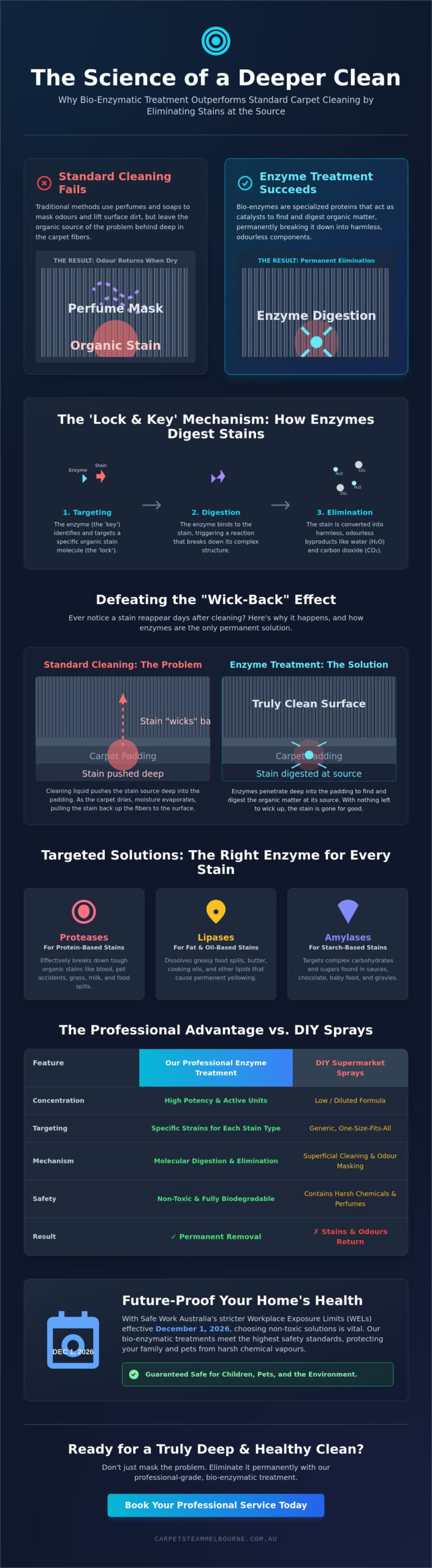
Understanding the science behind deep sanitisation starts with the “Lock and Key” mechanism. Unlike traditional soaps that use surface tension to lift dirt, enzymes are biological specialists. Each enzyme molecule has a unique shape that fits perfectly into a specific type of organic waste. When we use Enzyme treatment, we aren’t just applying a generic soap. We’re deploying targeted proteins that latch onto stains like pet urine, milk, or blood. Once the “key” (the enzyme) fits the “lock” (the stain), it triggers a chemical reaction that breaks the bond of the organic matter.
This digestion process is thorough. It converts complex, foul-smelling organic molecules into simple, odourless substances like water and carbon dioxide. Because these cleaners are biological, they are extensively tested and proven safe for consumer use in residential environments. One of the biggest advantages is the residual effect. Enzymes don’t stop working the moment we turn off the steam cleaner. They continue to “eat” away at microscopic particles deep within the carpet backing for several hours after the service is complete, ensuring a level of sanitisation that standard chemicals cannot match.
The ‘Big Three’ Enzymes in Professional Cleaning
We select our formulas based on the specific needs of your Melbourne home. We generally rely on three main types of enzymes to handle different household accidents:
- Proteases: These are essential for protein-based accidents. They break down the stubborn bonds in blood, grass, and meat juices that often leave permanent marks.
- Lipases: These target lipids. If you’ve spilled greasy food or butter, lipases dissolve the fats that usually cause permanent yellowing and attract dirt.
- Amylases: These tackle starches. They are perfect for cleaning up sugary residues from soft drinks or pasta sauces that make carpet fibres feel stiff and sticky.
Dwell Time: Why Patience Equals a Cleaner Home
Professional cleaning isn’t a race; it’s a scientific process. When applying these treatments, we allow for a “dwell time” of 10 to 15 minutes. This period is crucial because enzymes need time to physically digest the organic material. It’s the difference between simple “wetting” and active biological digestion. Our technicians also manage the temperature carefully. While the heat from professional steam cleaning helps activate the enzymes, excessive heat can denature them. We strike the perfect balance to maximise activity without destroying the proteins. This meticulous approach is why our results last longer than a standard quick-scrub service.
Why Standard Cleaning Fails Where Enzymes Succeed
Have you ever noticed a stain disappear after a professional clean, only to have it “ghost” back into view 48 hours later? This is known as the wick-back phenomenon. Standard cleaning relies on detergents that reduce surface tension to lift dirt, but they often fail to reach the carpet backing or underlay where organic spills settle. When the moisture evaporates, capillary action pulls the underlying organic matter back to the surface. We use Enzyme treatment to stop this cycle permanently. Instead of just moving the dirt around, enzymes destroy the molecular bonds of the organic source. There is nothing left to “wick back” because the stain has been digested at its origin.
Standard detergents can actually make your carpet get dirty faster. Many traditional cleaners leave behind a sticky, high-pH residue that acts like a magnet for Melbourne dust and grime. Enzymes are fundamentally different. They are generally pH neutral and leave no tacky film behind. This ensures your carpet stays cleaner for longer and maintains its soft, natural feel. By choosing a biological solution over a chemical one, you avoid the common trap of “clean” carpets that feel crunchy or attract new spots within weeks.
The Battle Against Pet Urine and Odours
Pet urine is notoriously difficult because it contains uric acid. When urine dries, it forms insoluble salt crystals that standard steam cleaning simply cannot dissolve. These crystals remain trapped in the fibres, releasing foul smells every time the Melbourne humidity rises. Enzymes are the only solution capable of breaking down the urea and urochrome responsible for the yellow colour and pungent scent. For severe cases involving large liquid spills or saturation, we often integrate this with our Emergency Flood Damage Restoration Melbourne service to ensure the subfloor and underlay are also treated.
Chemical Safety and pH Balance
Many traditional cleaners use high-pH chemical strippers that can be aggressive on delicate wool rugs or natural fibres. These harsh solvents are coming under increased scrutiny. With Safe Work Australia’s December 1, 2026, regulations tightening limits on airborne contaminants, enzyme-based solutions offer a safer, non-toxic alternative. They are gentle on your carpet’s pile but ruthless on organic stains. This is especially important for households with toddlers or pets who spend time playing on the floor. You get a deep sanitisation without the risk of chemical burns or lingering toxic vapours, ensuring your home environment remains healthy and safe.
When to Request an Enzyme Treatment: A Homeowner’s Checklist
Not every spill requires a biological intervention, but failing to recognise a biological threat can lead to permanent damage. Standard steam cleaning is excellent for removing dust, pollen, and general grit. However, it often falls short when dealing with living proteins that have begun to decompose. In Melbourne’s damp climate, organic material can start to rot within 24 to 48 hours, creating a breeding ground for bacteria. We use Enzyme treatment specifically for these scenarios because it addresses the biological reality of the stain rather than just the visual surface. Early intervention is the most effective way to prevent odours from becoming a permanent part of your home’s atmosphere.
Distinguishing between biological and synthetic stains is the first step. Synthetic stains, like ink or food dye, require chemical solvents to break the bond with the fibre. Biological stains, such as pet accidents, milk, or blood, are organic. They contain proteins and fats that standard detergents cannot fully dissolve. If you notice a lingering smell that worsens on a humid Melbourne afternoon, you’re likely dealing with organic residue trapped in the carpet backing. This is especially critical for end-of-lease agreements. In 2026, Victorian property managers have become significantly more stringent regarding pet odours, often requiring proof of professional-grade sanitisation to release a bond.
Top 5 Scenarios for Professional Enzyme Application
- Pet accidents: Urine, faeces, or vomit that has penetrated through the pile and soaked into the underlay.
- Dairy and food spills: Milk, wine, or meat juices that have developed a sour or putrid odour over time.
- Mould and mildew: Remediation for damp ground floors or basements where spores have begun to colonise the fabric.
- End of Lease: Bond returns for pet-friendly rentals where property managers require proof of professional sanitisation.
- Mattress and upholstery: Deep sanitisation of sweat and skin cell buildup that attracts dust mites.
Before booking, check our Professional Carpet Steam Cleaning Melbourne guide to see how these treatments integrate with our standard deep-cleansing packages.
Testing for Organic Residue
Don’t rely on the “sniff test” alone. By the time you can smell an odour, the bacteria colony is already well-established. Our technicians use high-intensity UV lights to identify hidden organic matter that is invisible to the naked eye. This allows us to target our application precisely where it is needed most. To prepare for your service, blot up any fresh spills with a dry towel immediately, but avoid using supermarket sprays. These products often set the stain or interfere with the enzyme’s ability to digest the organic proteins. Clear the area of small furniture to ensure 100% coverage during the application. For a home that is truly sanitised and safe for your family, request a professional quote today and experience the difference of molecular cleaning.
The Professional Advantage: Why Best Carpet Steam Cleaning Melbourne Uses Enzymes
Choosing a cleaning provider in 2026 requires looking beyond the lowest price. At Best Carpet Steam Cleaning Melbourne, we align our processes with the latest Australian health and safety regulations. With the stricter Safe Work Australia Workplace Exposure Limits (WELs) coming into effect on December 1, 2026, our move toward bio-enzymatic solutions is a proactive step for your safety. we use Enzyme treatment because it represents the pinnacle of modern sanitisation technology. It provides a level of deep-cleansing that standard detergents simply cannot match, especially when dealing with the complex organic proteins found in Melbourne households. Our commitment is simple: we provide a home that smells truly clean, not just one that’s been sprayed with synthetic perfume.
The real magic happens through the synergy of our high-powered steam extraction and enzymatic pre-treatments. While the enzymes digest the organic matter at a molecular level, our industrial-grade steam equipment flushes the residue away. This dual-action approach ensures that no biological traces are left behind to cause future odours. We understand that accidents happen at the most inconvenient times. That’s why we offer same-day service for urgent organic spill management. If you have a major pet accident or a significant food spill, waiting even 24 hours can allow bacteria to settle. We act fast to protect your investment.
Our Specialised Melbourne Cleaning Process
We follow a rigorous three-step protocol to ensure every fibre is restored to its original condition. First, we perform industrial-strength vacuuming to remove dry soil and grit that can act like sandpaper on your carpet pile. Second, we apply a targeted enzyme pre-spray to high-traffic zones and specific accident areas. This gives the proteins time to break down the organic bonds. Finally, we use deep steam extraction to thoroughly flush away the digested matter, leaving your carpets sanitised and residue-free.
Service Areas and Local Expertise
Our team of local experts understands the unique challenges of Victorian homes. We serve a wide range of areas, including Rockbank, Point Cook, Ballarat, and the entire Melbourne metro region. Local knowledge matters because Melbourne’s water hardness can vary significantly between suburbs. We adjust our enzyme concentrations and water temperatures to account for these mineral levels, ensuring maximum activation of the cleaning agents. We stand by our work with a 100% satisfaction guarantee. If the organic odour remains after our visit, we haven’t finished the job. We’ll return to make it right, giving you total peace of mind. Book your professional enzyme treatment with Best Carpet Steam Cleaning Melbourne today.
Restore Your Home’s Hygiene with Molecular Science
You now understand why standard soaps fail against uric acid and organic proteins. By targeting the molecular structure of a stain, we ensure that odours don’t return once the carpet dries. We use Enzyme treatment to provide a level of deep sanitisation that protects your family from the harsh chemical residues common in older cleaning methods. This approach is the only way to meet the strict 2026 health standards while keeping your home smelling truly fresh. It’s a scientific solution for a common household problem.
Don’t settle for temporary fragrance fixes that only mask the issue. Our team provides same-day service across Melbourne to handle urgent spills before they bond with your carpet fibres. We stand behind every job with a 100% satisfaction guarantee; if the odour isn’t gone, we aren’t finished. Our non-toxic, pet-safe bio-enzymes deliver professional results that are both affordable and effective for busy families. Get a Free Quote for Professional Enzyme Carpet Cleaning in Melbourne today. Let’s restore your home to its healthiest state.
Frequently Asked Questions
Is an enzyme treatment safe for my pets and children?
Yes, enzyme treatments are completely safe for children and pets. These bio-enzymatic cleaners are non-toxic and don’t release harmful VOCs into your home. This is especially important given the December 1, 2026, safety standards from Safe Work Australia. You don’t have to worry about chemical burns or skin irritation once the carpet dries.
How long does it take for the enzyme treatment to work on my carpet?
The active digestion process takes approximately 10 to 15 minutes of dwell time during the service. While the enzymes work quickly to break down organic bonds, the full sanitisation effect continues for several hours as the carpet dries. We ensure the treatment is properly activated by managing water temperature and humidity for the best results.
Can enzymes remove old, set-in pet urine smells?
Yes, enzymes are the only effective way to remove old, set-in pet urine smells. Standard steam cleaning can’t dissolve the dried uric acid crystals that cause lingering odours. We use Enzyme treatment to physically digest these crystals at a molecular level. This prevents the “wick-back” effect where smells return when the weather gets humid.
Do I need an enzyme treatment if I don’t have pets?
You definitely benefit from an enzyme treatment even without pets. Household carpets accumulate skin cells, sweat, and food particles that attract dust mites and bacteria. These organic materials cause a “stale” smell over time. A professional enzyme application removes these invisible contaminants, improving your indoor air quality significantly compared to standard vacuuming alone.
Will an enzyme treatment change the colour or texture of my carpet?
No, an enzyme treatment will not change the colour or texture of your carpet. These solutions are generally pH neutral and designed to be gentle on delicate fibres like wool or nylon. Unlike high-pH chemical strippers, enzymes don’t leave a crunchy residue. Your carpet will feel soft and natural once the cleaning process is complete.
What happens if the organic stain has reached the carpet underlay?
If a stain has reached the underlay, we use a deeper saturation method to ensure the enzymes reach the source. Organic liquids like urine or milk often sink below the surface fibres. In these cases, we apply a heavier volume of treatment and use high-powered extraction to flush the underlay. This prevents deep-seated bacteria from causing future odour issues.
Are your enzyme treatments eco-friendly and biodegradable?
Yes, our enzyme treatments are 100% biodegradable and eco-friendly. They break down into harmless water and carbon dioxide after they finish digesting the organic matter. This aligns with our commitment to modern, sustainable cleaning standards in 2026. You get a professional-grade result without leaving any lasting environmental footprint in your local Melbourne community.
Can I use an enzyme treatment on my couch or mattress as well?
Yes, you can absolutely use an enzyme treatment on your couch or mattress. We frequently apply these solutions during upholstery and mattress cleaning to handle sweat, body oils, and food spills. We use Enzyme treatment to ensure these deep-seated organic particles are removed from the foam and fabric, providing a hygienic sleeping or seating surface.
