Water Damage Restoration Melbourne: The Essential 2026 Recovery Checklist
Did you know that burst pipes account for 46% of all water damage insurance claims in Australia? If you’re currently standing on a soaked carpet or staring at a leaking ceiling, you know that professional water damage restoration is a high-stakes race against biology. It’s completely normal to feel overwhelmed by the fear of permanent structural rot or the health risks of rapid mould growth. You need a dry, safe, and sanitised home, and you need to know that your insurance claim is handled correctly under Victoria’s latest regulations.
We understand that your peace of mind depends on fast, expert action. This 2026 recovery checklist provides a comprehensive, step-by-step guide to securing your property according to the new AS-IICRC S500:2025 national standards. We’ll show you exactly how to document evidence for the Building and Plumbing Commission (BPC), navigate the “first-resort” insurance model, and apply the scientific drying methods needed to prevent long-term damage. From the first 24 hours of mitigation to final sanitisation, this guide ensures your Melbourne home is restored to the highest professional standard.
Key Takeaways
- Learn the critical first steps to secure your property, including how to safely isolate power and stop the flow before structural damage sets in.
- Discover how professional water damage restoration uses thermal imaging and moisture mapping to locate hidden dampness that standard drying methods miss.
- Identify the “dry to the touch” fallacy and why treating surface moisture alone often leads to long-term mould issues and structural rot.
- Navigate the 2026 insurance landscape with a detailed documentation checklist designed to meet the latest Victorian regulatory requirements.
- Access a 24/7 emergency roadmap to move from flood-damaged chaos to a fully sanitised, safe, and dry home environment.
Immediate Emergency Checklist: Safety and Damage Mitigation
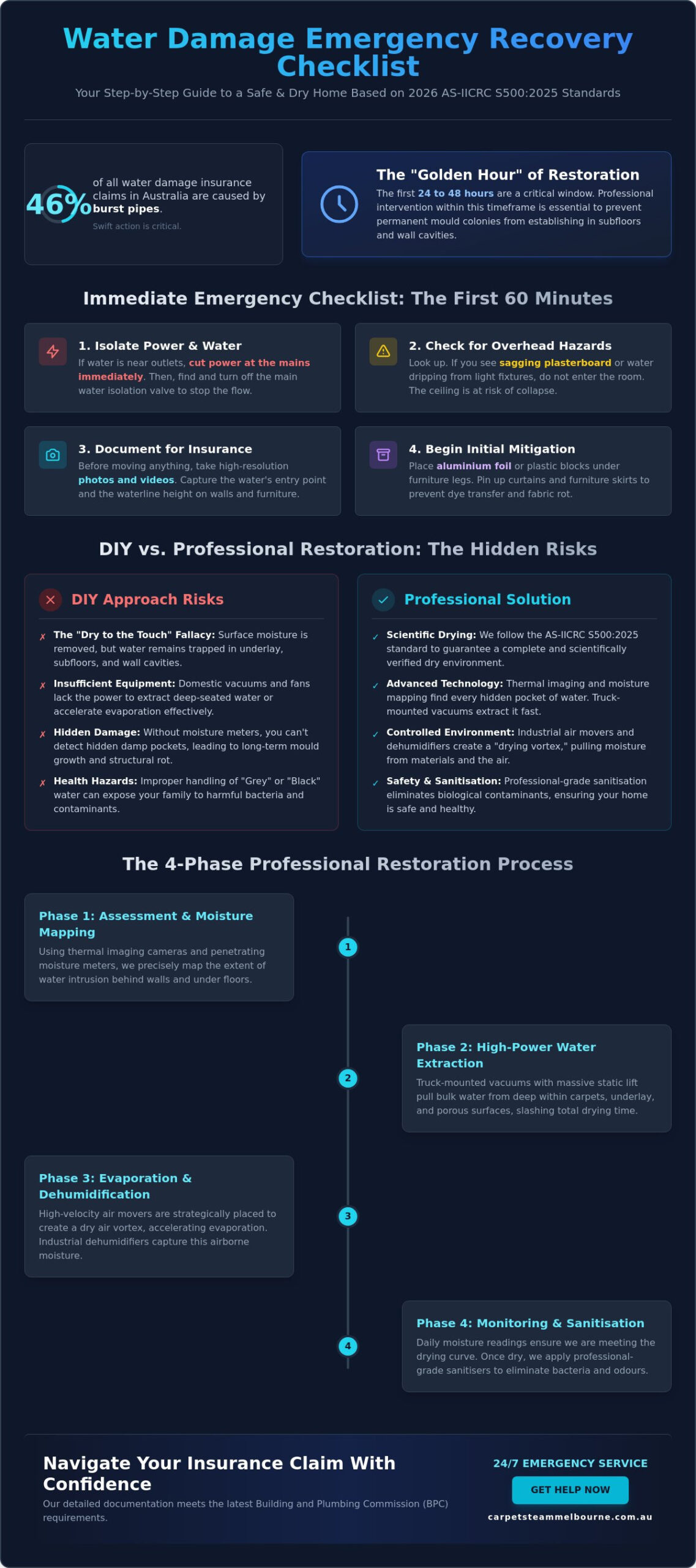
When water enters your home, your first 60 minutes dictate the next six months of your life. You must act with speed and precision to protect both your family and your property’s structural integrity. Start by cutting the power at the mains if water has reached any wall sockets, floor outlets, or appliances. Electrical conductivity in standing water is a lethal risk that requires immediate attention before you begin any water damage restoration efforts. Once the area is electrically safe, identify the source of the intrusion. If you’re dealing with a burst pipe, which accounts for 46% of Australian water claims, turn off the main water isolation valve immediately. For roof leaks or sewage backups, clear the area and prepare for professional intervention.
Grab your phone and document the scene before you touch or move anything. Take high-resolution photos and videos of every affected room, specifically capturing the water’s entry point and the height of the waterline on your skirting boards. This digital evidence is vital for the Building and Plumbing Commission (BPC) and your insurer’s assessment. Wear heavy-duty rubber boots and waterproof gloves during this process. Melbourne storm floods often carry bacteria, silt, and chemical runoff, making protective gear essential to avoid skin infections or respiratory issues.
The 15-Minute Safety Protocol
Look up before you walk into any saturated room. If you see sagging plasterboard or water dripping through light fixtures, the ceiling is at risk of collapse; stay out of these zones entirely. Avoid all contact with “Grey” or “Black” water, as these categories contain significant levels of biological contaminants that require professional-grade sanitisation. The “Golden Hour” of restoration is the first 24 to 48 hours, as this is the critical window where professional intervention can still prevent permanent mould colonies from forming in your subfloors and wall cavities.
Initial Mitigation Steps
Protect your furniture and textiles while waiting for our emergency team to arrive. Pin up long curtains and lift furniture skirts off the wet carpet to prevent dye transfer and fabric rot. Place small squares of aluminium foil or plastic blocks under the legs of sofas and tables. This simple barrier stops wood tannins and metal rust from permanently staining your floor fibres. Only open your windows if the outdoor humidity in Melbourne is lower than the indoor level. If it’s a humid or rainy day, keep the house sealed to prevent external moisture from fueling further mould growth before the industrial dehumidifiers are deployed.
The Professional Water Damage Restoration Checklist
Every minute water sits in your subfloor, the risk of structural failure increases. Scientific water damage restoration follows a strict protocol to ensure every drop is accounted for, moving far beyond what simple surface cleaning can achieve. Our process begins with high-powered extraction using truck-mounted vacuums. These units provide the massive static lift required to pull liquid from deep within carpet underlay and porous floorboards. By removing the bulk of the water immediately, we significantly reduce the total drying time and the likelihood of secondary damage like floorboard cupping or tile delamination.
Hidden pockets are the enemy of a dry home. Our technicians use advanced moisture mapping to locate water that the human eye cannot see. By utilizing thermal imaging cameras and penetrating moisture meters, we track how far liquid has traveled behind your plasterboard and under your cabinetry. This data allows us to create a precise “drying plan” that targets the most saturated zones first. If you’re unsure about the extent of the dampness in your walls, contacting Melbourne restoration experts for a professional assessment is the safest way to prevent long-term structural rot.
The Extraction and Evaporation Phase
Domestic vacuum cleaners and standard pedestal fans are simply insufficient for professional water restoration. They lack the power to break the surface tension of water trapped in thick padding. Instead, we deploy high-velocity air movers. These industrial machines are positioned to create a “vortex” of dry air across the floor, which accelerates the evaporation of moisture from the material into the air. Monitoring this progress is vital. We take daily moisture readings to ensure the environment is following the drying curve established by the AS-IICRC S500:2025 standard.
Dehumidification and Odour Control
Once moisture is in the air, it must be removed to prevent it from soaking back into your ceiling or furniture. We use LGR (Low Grain Refrigerant) dehumidifiers, which are engineered to continue pulling water vapor even in very dry or cold conditions. This is essential for extracting moisture from deep timber frames and sub-floors. To ensure your air is as clean as your floors, we also utilize HEPA air scrubbers. These units filter out 99.97% of airborne spores and bacteria that thrive in damp environments. Unlike older ozone treatments, our hydroxyl generators safely neutralise odours while you remain in the home, providing a non-toxic solution for a fresh, healthy environment.
DIY vs. Professional Restoration: Assessing the Risks
Many homeowners make the mistake of assuming that once a carpet feels dry to the hand, the danger has passed. This is known as the “dry to the touch” fallacy. While the surface fibres may feel crisp, the thick underlay and the timber subfloor beneath often remain saturated. Without industrial-grade water damage restoration, this trapped moisture creates a stagnant environment where structural rot and microbial growth thrive. In Melbourne’s older homes, particularly those with original hardwood, this hidden dampness leads to “cupping,” where floorboards warp and lift at the edges, often requiring a total floor replacement that costs thousands more than the initial drying service.
The wicking effect is another silent threat to your property. Much like a sponge, porous materials like plasterboard and insulation pull water upwards from the floor. Liquid can travel up to 400mm vertically into your walls within the first few hours of a leak. This hidden moisture compromises the structural integrity of your wall studs and provides a perfect breeding ground for mould. You have a strict 48-hour window before mould spores begin to colonise in humid conditions. Once these colonies establish themselves deep within your wall cavities, they become a permanent health hazard that simple surface cleaning cannot fix.
When DIY is (and isn’t) Appropriate
You can often manage minor “Clean Water” spills, such as a small overflow from a bathtub or a leaking fridge that covers less than 2 square metres, using a high-powered shop-vac and heavy-duty fans. However, if the water is “Grey” (from a dishwasher or washing machine) or “Black” (sewage or outdoor floodwater), you must avoid DIY methods. These Category 3 biohazards contain pathogens and bacteria that require professional-grade antimicrobial treatments. The cost of failure is steep; saving $500 on a DIY attempt today often results in a $10,000 mould remediation bill six months later when the hidden infestation finally becomes visible. This same principle applies to other hazardous situations in the home — understanding the risks of DIY versus professional intervention is critical, as explored in this guide to professional scene cleanup in Melbourne and the myths surrounding it.
The Science of Secondary Damage
Hygroscopic materials are substances, such as timber, plasterboard, and even your furniture fabrics, that actively attract and hold water molecules from the surrounding environment. This means that even if a room wasn’t directly flooded, high indoor humidity caused by standing water elsewhere can damage items in a completely different part of the house. Melbourne’s variable climate often traps high humidity indoors, slowing down natural evaporation and accelerating the degradation of your belongings. Don’t rely on household bleach to fix the issue. Bleach is mostly water; it may kill surface mould, but the moisture it leaves behind actually feeds the roots of the infestation deep inside the material. Professional sanitisation is the only way to ensure a truly safe home environment.
Melbourne Insurance Claims: A Documentation Checklist
Navigating an insurance claim after a flood can feel like a second disaster. To ensure a successful payout, you must understand your “Mitigation Clause.” Almost every Australian residential policy includes a legal obligation for the homeowner to take reasonable steps to prevent further loss. If you leave a carpet saturated for days while waiting for an assessor, the insurer may deny coverage for the resulting mould or structural rot. Engaging professional water damage restoration immediately fulfills this requirement. It proves you acted decisively to protect the asset, which is the first thing a claims handler looks for in your file.
Review your Product Disclosure Statement (PDS) for the specific definitions of “Flood” versus “Storm or Liquid Damage.” In the insurance world, “Flood” usually refers to water escaping from a natural watercourse like a river or lake. “Storm or Liquid Damage” covers burst pipes, overflowing sinks, or rain entering through a damaged roof. Since 2026, the Building and Plumbing Commission (BPC) has provided stronger oversight for these disputes in Victoria, but your documentation remains your best weapon. Under the General Insurance Code of Practice, your insurer is required to provide you with a claim update every 10 business days and must reach a decision within four months for standard cases.
Working with Victorian Insurers
Major insurers like RACV, Allianz, and NRMA often point homeowners toward “preferred repairers.” You aren’t always required to use them. You have the right to choose a local Melbourne expert who prioritises your home’s long-term health over the insurer’s bottom line. Always request an “Emergency Make Safe” certificate from your technician. This document acts as official proof that the property was secured and the drying process began according to the AS-IICRC S500:2025 standard. If you need a certified report to jumpstart your claim, book an emergency inspection with our team today.
Itemising Losses
Create a room-by-room inventory before any items are moved. Take high-resolution photos of the front and back of damaged electronics, furniture, and textiles. Do not throw anything away yet. Even if a mattress or rug is clearly unsalvageable, the assessor needs to see the physical item to verify its value. We help you distinguish between restorable items, which can be saved through advanced steam cleaning and sanitisation, and total loss items. Keep a chronological Evidence Log that notes every phone call with your insurer, the names of representatives, and the specific times that restoration work was performed on-site.
Why Best Carpet Steam Cleaning Melbourne is Your Restoration Partner
When a flood strikes, you need more than just a drying technician; you need a team that takes ownership of your home’s recovery. Best Carpet Steam Cleaning Melbourne provides a 24/7 emergency response across the CBD, Rockbank, and all surrounding suburbs. We use advanced water damage restoration techniques to stabilise your property and prevent secondary damage from taking hold. Our IICRC-trained experts use the latest moisture detection sensors to ensure no dampness is left behind in your subfloors. We pride ourselves on professional service with transparent pricing, ensuring you aren’t hit with unexpected fees during a crisis.
Our commitment to excellence means we don’t just meet industry standards; we exceed them. By deploying truck-mounted extraction units and high-capacity LGR dehumidifiers immediately, we significantly reduce the time your home remains under threat. We understand the urgency of the situation and act with the brisk, purposeful rhythm required to save your flooring and furniture. Trust our local experts to provide a 100% satisfaction guarantee while restoring your property to its pre-loss condition.
Our Local Melbourne Expertise
As a family-owned business, we understand the unique challenges Victorian weather patterns present to local homes. We don’t just clear the water; we ensure your environment is safe for your children and pets. By using non-toxic, eco-friendly sanitisation methods, we eliminate bacteria without introducing harsh chemicals into your living space. This commitment to safety and ethics makes us a trusted choice for flood damage restoration melbourne.
Beyond Restoration: Full Property Rejuvenation
We offer a complete solution that goes beyond just drying your structural elements. Once your property is stable and the moisture levels are verified, we transition seamlessly into high-standard carpet steam cleaning melbourne to remove silt, debris, and allergens. Our team also handles specialised tile and grout cleaning to restore your hard surfaces to their original shine. We are hardworking, no-nonsense professionals dedicated to your peace of mind. Contact us today for an immediate assessment and let our local experts handle the hard work for you.
Secure Your Home and Health Today
Recovering from a flood is about more than just removing standing liquid. It’s a precise process of scientific drying and sanitisation. By following this 2026 checklist, you’ve learned that immediate action within the first 48 hours is the only way to stop mould colonies and structural rot. Professional water damage restoration ensures that hidden moisture in your wall cavities and subfloors is fully eliminated before it causes permanent damage. Don’t risk your family’s health or your property’s value on “dry to the touch” guesswork.
Our team is ready to help you navigate the insurance process with detailed reports and expert evidence logs. We combine a 24/7 emergency response across Melbourne with specialist moisture detection technology to provide an accurate, science-based recovery. Our IICRC Certified Technicians are committed to returning your home to a safe, dry, and healthy state with a 100% satisfaction guarantee. You can move past this disaster with confidence and speed. We’re here to help you every step of the way.
Get 24/7 Emergency Water Damage Help in Melbourne Now
Frequently Asked Questions
How long does the water damage restoration process usually take in Melbourne?
The standard water damage restoration timeline in Melbourne is usually 3 to 5 days. This period allows our high-velocity air movers and LGR dehumidifiers to pull moisture from deep within structural materials. While surface drying happens quickly, reaching “dry standards” for timber and subfloors takes longer. Factors like Melbourne’s outdoor humidity and the volume of water involved will influence the final schedule for your property’s recovery.
Can I stay in my home during the drying and restoration process?
You can often stay in your home if the damage is limited to a single room and involves clean water. However, if you’re dealing with a Category 3 sewage backup, we recommend vacating until the sanitisation phase is complete. Industrial air movers are also quite loud and run 24/7. Most families find the noise and the constant presence of drying equipment too disruptive for overnight stays.
Will my insurance cover the cost of professional water damage restoration?
Most Australian insurance policies cover professional water damage restoration if the cause is sudden and accidental, such as a burst pipe. You must act quickly to fulfill your “Mitigation Clause” and prevent secondary issues like mould. We provide the detailed IICRC-certified reports and moisture logs your insurer needs to process the claim. Always check your specific Product Disclosure Statement to confirm your coverage limits and any applicable excesses.
What is the difference between flood damage and water damage in Australia?
In Australia, “Flood” specifically refers to water escaping from a natural watercourse like a river, creek, or lake. “Water damage” generally covers internal plumbing failures, burst pipes, or rain entering through a damaged roof. This distinction is critical because many standard home insurance policies exclude natural floods but include storm and liquid damage. Always verify which category your specific event falls under with your insurance provider.
Is it possible to save a carpet that has been soaked by sewage water?
No, you can’t safely save a carpet or underlay that has been saturated by sewage water. This is classified as Category 3 “Black Water” and contains dangerous pathogens and bacteria. For your family’s safety, these porous materials must be removed and discarded immediately. Our focus then shifts to deep-cleansing and sanitising the underlying subfloor to ensure the environment is safe before you install any new flooring.
How do I know if there is hidden mould growing behind my walls?
A persistent musty odour or visible staining on skirting boards are the most common signs of hidden mould. Water often travels up to 400mm vertically inside your wall cavities through the wicking effect. Because mould can begin colonising within 48 hours, we use thermal imaging and moisture meters to find dampness that isn’t visible. Professional moisture mapping is the only way to confirm if your walls are truly dry.
Do I need to replace my floorboards after a major leak?
Floorboard replacement isn’t always necessary if the timber hasn’t suffered permanent warping or “cupping” from prolonged exposure. If we begin the extraction process within the first 24 hours, our LGR dehumidifiers can often pull the moisture out before the wood cells distort. We monitor the drying progress daily with moisture meters to ensure the timber returns to its pre-loss moisture content safely and effectively without replacement.
Why does my house smell musty even after the water has been sucked up?
A musty smell remains because surface extraction doesn’t remove the moisture trapped inside porous building materials. These smells are caused by microbial volatile organic compounds released by dampness or early mould growth. To eliminate the odour, we must lower the relative humidity and use HEPA air scrubbers to clean the air. Simply “sucking up” the water is only the first step in a complete, professional recovery.
